Showing posts with label Lutzen. Show all posts

Friday, 20 November 2020

Old Blue And Other Colours

“These 2 brigades were of the flower of the Army: old souldiers of 7 or 8 yeeres service (the most of them) and whom the King had there placed, for that he most relied on them.” Williams Watts describing the Old Blue and Yellow Brigades at the Battle of Lutzen.

This blog post looks at my approach to representing the Swedish infantry brigades of the Thirty Years War, in partiocular those at Lutzen 1632, using the Pike and Shotte rule system from Warlord Games.

The Swedish ‘colour’ infantry brigades, with their elaborate ‘squadron’ formations, are for me an iconic part of the Swedish army in this period.  I want to be able to reflect these formations, and explore their tactics, in my miniature versions of these brigades.

Here is a brief background to the Swedish infantry brigades of the period. 

(The Osprey “The Army of Gustavus Adolphus: Infantry (Men-at-Arms)” by Richard Brzezinski is an excellent introduction to this topic.) 

As Gustav Adolph’s main field army evolved during the 1620s key infantry regiments became known by the colour of their flags as well as their colonels’ names; hence we get the Yellow Regiment, the Green regiment, the Red regiment and so on.  Regiments, which were mainly an administrative formation, were grouped in to brigades for battles.  The brigades were named after their senior Oberst (Colonel) who commanded the brigade, or more simply the senior regiment’s colour.  So you have the Yellow brigade, the Green brigade etc. (It is worth noting that the Swedish army was recruited from across Europe, and at Lutzen the majority were German, but also with many Scots, and other nationalities, as well as Swedes.)

Gustav Adolph experimented and evolved how these brigades were organised as well as the tactics and formations used on the battlefield.  On the battlefield a brigade was broken down in to units, of around 500 men, called squadrons. Regiment strengths varied so that a brigade may be made up of one strong regiment, or a number of smaller regiments, so that it had enough men to form the required number of squadrons.  Each squadron in the brigade was made up pike and musket armed troops, with the ideal ratio of muskets to pikes generally increasing over time.

This picture shows a simplified view of a three squadron brigade.  This assumes a ratio of one pike to one musket.  As time went on squadrons would have had less pike and/or more musket.  Surplus musketeers were formed in to a reserve within the brigade, or were detached from the brigade and became ‘commanded shot’ supporting the cavalry, or carrying out some other separate function.  Using the three squadron brigade as a model, and using the quite detailed information available on the strengths of brigades, with the ratio of musket to pike for the Swedish infantry at Lützen I set about planning my toy soldier version of the Swedish infantry.  (See Osprey Campaign #68 Lützen 1632, by Richard Brzezinski for more info.)

My Old Blue Brigade


Here is how I formed my version of the (Old) Blue Brigade.  This brigade was made up of a single regiment, the Old Blue regiment, that was one of Gustav Adolph’s oldest regiments, recruited mainly with Germans. The epitaph ‘old’ was used informally to distinguish the regiment from a more recently formed Blue regiment, that was sometimes called the New Blue regiment, or the Swedish regiment, as it was recruited from native Swedes. The Old Blue regiment served from 1624 and was finally disbanded in 1652. 

It seems likely that the regiment had blue uniforms as well as blue flags.  I chose to show the unit in a variety of shades of blue to reflect different issues of cloth being provided to the troops over time.  Uniforms for the Swedish infantry were at the whim of their colonel and the availability of cloth where ever the regiment was serving.  

Although quite a strong regiment, as it formed a brigade on its own, it was one of the smaller brigades at Lutzen. It also had a roughly one to one proportion of pikes to muskets.  I therefore form the brigade as three ‘small’ pike units, and three ‘small’ musket units.  Each squadron in the brigade is made up of one pike unit and one musket unit.  There is also a light gun model and crew to represent the three pounder guns that were integral to each regiment.  

In Pike and Shotte (P&S) units are classified in to three basic size categories: small, regular and large.  At the Friends of General Haig club we tend to use 8 figures in two ranks for small infantry units, 12 figures for regular, and 16 for large.  So for Lutzen this means that the Old Blue Brigade of around 1,100 men scales down in my miniature version of the brigade to roughly 50 figures, with each figure therefore representing about 20 men.

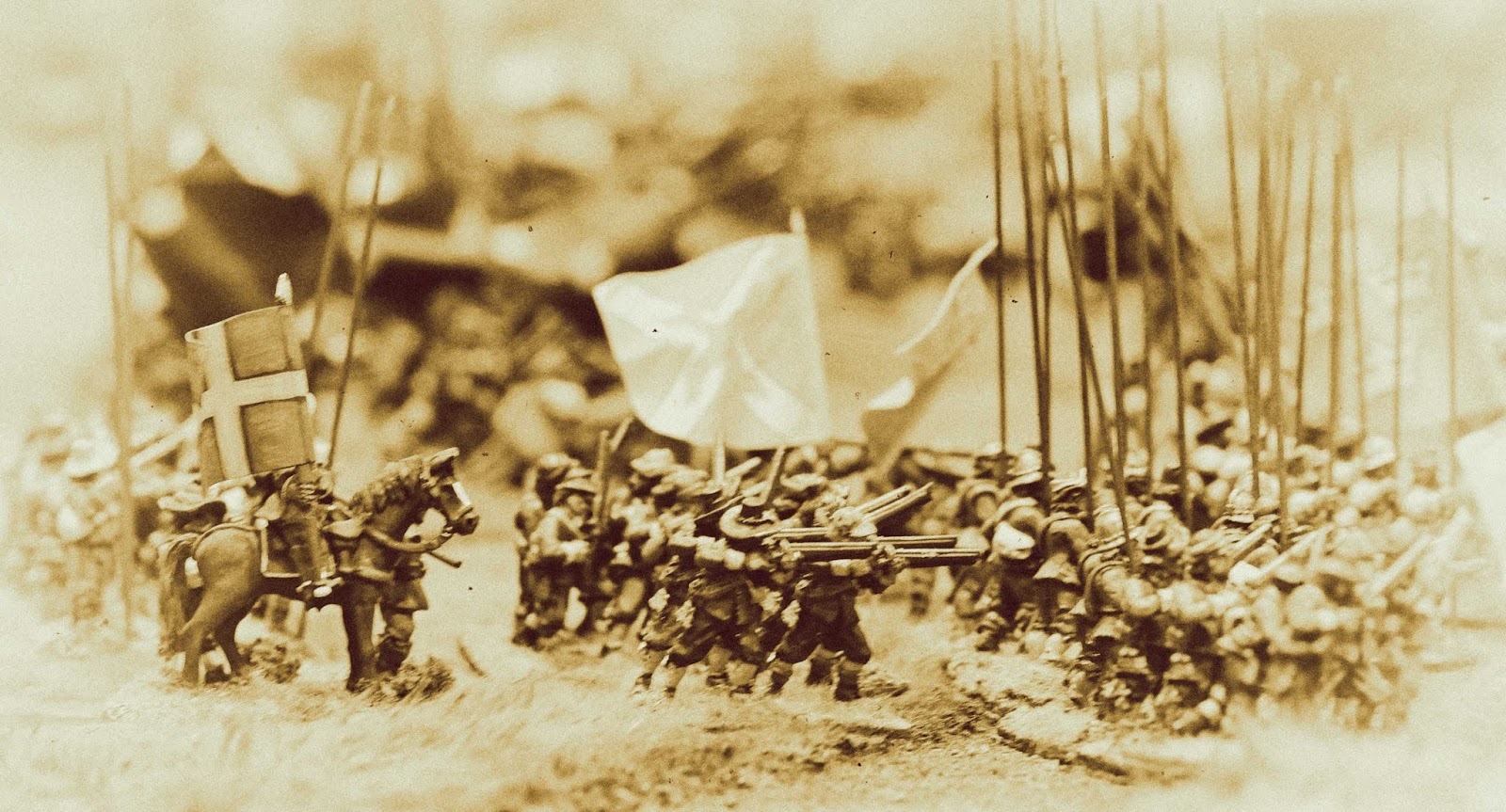
During the battle of Lutzen the Blue brigade were attacked and roughly handled by Imperial cuirassiers.  I therefore have the pike in the ‘charge for horse’ pose.  (A bit of a pain with the long pikes, but I think it looks great!). The pike are a mixture of Foundry and Warlord, and the musket mostly Warlord, with the odd Foundry or Perry officer mixed in.  The light gun is from Warlord.


To control this complex formation in P&S games each brigade has its own Commander, and so this circular command base represents Oberst Winckel, the regiment and brigade commander.  Winckel and one ensign are Foundry, and the other ensign Warlord. All flags from Flags of War.

To bolster his cavalry formations, Gustav Adolph deployed small units of muskets and light guns from his foot brigades, with the cavalry.  Such detached musketeers were known as “Commanded Shot”.  In P&S I use small units of musket with a light guns to represent these supports for the cavalry.  This unit of commanded shot represents men coming from the Blue Brigade.  This units is mostly Warlord.  I like the kneeling and standing figures showing a salvo being fired, and the helmeted figures representing those making some effort to protect themselves while fighting amidst the swirling cavalry melees. (All Swedish musketeers were meant to wear helmets but it seems that most did without what must have seemed an unnecessary encumbrance for most of the time during a campaign.) 

On the wargames table

Having a larger number of smaller units, compared to the more conventionally organised infantry (with a single pike block and two wings of musket), needs a better level of command, and the small units can be brittle.  However the Swedish brigades are very flexible, difficult to outflank, and can out manoeuvre more unwieldy opponents.  It produces a very interesting asymmetry between the Imperial and Swedish foot that can spice up a Pike and Shotte game.

To represent the more experienced of the Swedish brigades at Lutzen (such as the Old Blue and Yellow brigades) I have experimented with adding P&S special rules such Drilled, Stubborn, and Salvo.  Other brigades, which fielded more men than the Old Blue, will also have larger, and potentially more, component units.

The commanded shot and light guns supporting the cavalry can be effective, but seem to be often left behind by their commanders in wargames who, at Lutzen, are in a hurry to capitalise on the Imperial weakness in cavalry numbers early in the battle before they are reinforced.  

I would be interested in any other ideas people have for representing the Swedish brigades on the table top.

Until next time!

Andy @ FOGH 


Sunday, 4 August 2019

The Bloody Clash At Lutzen - again!

"for had not our foote stoode like a wall, there had not a man of us come off alyve" 
Letter from George Fleetwood to his father, giving an account of the battle of Lutzen

Warlord Game Open Day - 20th July 2019

In a reprieve of the game at Salute this year, the Friends of General Haig (FOGH) put on the Lutzen 1632 game at this year’s Warlord Games Open Day.  This blog post is a description of the days action. 
The game set up and ready to start.
It was a warm and sunny morning as three intrepid members of the FOGH arrived at Lenton Business Centre in Nottingham, also known as Warlord Games HQ.  We had a couple of hours until the start of the open day at 1000, and so we got on with unloading the figures, terrain and other paraphernalia for the Lutzen game.  The Warlord chaps had set up tables etc. in the Marcus Garvey hall already for all of the games, and so we were soon busy deploying figures for the game of Pike and Shotte.
Game under way - Swedish Green brigade attacking Imperial centre.
With the games set up we had just enough time for breakfast, and a pre game briefing.  We headed for the splendid on site caterers who were starting to turn out all sorts of hearty breakfast fare.  In the bacon butty queue we bumped in to Warlord supremo, John Stallard, and Black Powder author, Rick Priestly, mentally preparing themselves for the day’s first presentation session.

Breakfast consumed we agreed who was doing what for the game.  The plan was to run the game in a participation style, allowing visitors to the open day to investigate the world of Pike and Shotte by playing a turn or two, in between them checking all of the other cool things going on.  So we had one commander for the Imperial forces, one as the Swedish commander, and a third to umpire / generally talk to people.  This allowed us to keep the game going throughout the day, and also to ensure that any participating players had someone on hand to advise them on what was going on, and how the rules worked.  We had also cut down the forces slightly from the game at Salute to try and simplify the game for anybody joining in, and to ensure we got to a conclusion in the day.   We also set definite objectives for the day.  Gustav Adolph and the Swedish led Protestant alliance (hence ‘the Swedes’) needed to take Wallenstein’s two Imperial batteries to win the game.  If the Imperial forces held these at the end of the day then it was a defeat for the Swedes.

I have uploaded the Orders of Battle to Google Drive here.

We had various people join in and roll some dice through the day, and of course lots more who wanted to come and talk about the game, figures and terrain.  Dan from Wargames Illustrated popped by for a quick interview with video shoot.  Also Guy from Wargames Soldiers and Strategy, and Mel the Terrain Tutor, stopped by to take some photos.  It was great to talk to so many people about the battle and wargaming this period, including some people who had seen the game at Salute.

See the Wargames Illustrated coverage of the whole event here on YouTube, we start at 4:57.

See the Wargames, Soldiers and Strategy pictures of the game here on their Facebook page.

How did the game play?  


Well, it started in a similar way to the previous run out.  Gustav Adolph set off with the right wing cavalry to try and overwhelm the opposing Imperial left wing.  Before the arrival of the Imperial reinforcements, under Pappenheim, the Swedes have an advantage in numbers here.   Unfortunately, also as usual, the Swedish commanded shot were left behind as their mounted brethren hurried to chase off the Croat light horse.  Chasing the fleet of foot Croats led the Swedish cavalry to crash in to   the supporting Imperial Cuirassiers and Arquebusiers.
Gustav Adolph encouraging forward his horse and commanded shot.
On the Swedish left wing it was a slower start and the Commanded shot here were sensibly detailed off to neutralise the Imperial commanded shot hiding in the gardens outside burning Lutzen.  This inactivity tempted forward the Imperial right wing Croats who started sniping at the Swedish horse, supported by long range fire from the Imperial ‘windmill’ artillery battery.
Lutzen on fire in the foreground, with the two armies stretched out in the background.  Imperial on the left, Swedish on the right.
Imperial Commanded shot in the gardens outside Lutzen under attack by Swedish commanded shot with a light gun.
In the centre the Swedish shifted two brigades, Old Blue and Duke Wilhelm’s, across to the right to support the right wing cavalry, and also to lead an assault on the smaller Imperial battery which sat at the junction of the Imperial left wing and centre.  Progress in the centre was general slow for the Swedes throughout the day.
Imperial 'small' battery on the left of the Imperial Centre.  Preparing for the Swedish onslaught.
The Imperial forces hunkered down to weather the initial storm of the Swedish attack, and waited for Pappenheim.
Imperial foot in the centre.
Despite having the advantage of numbers, command, and initiative, the Swedish right wing horse couldn’t break through the Imperial left wing opposite them, and started losing units to the ‘men in black’, the Imperial cuirassiers.   Knyphausen, who was the overall commander for the Swedish centre and reserve, brought across the single regiment of reserve horse to try and force a decision on the Swedish right.  It was nail biting stuff.  Wallenstein, Imperial Generalissimo, was anxiously looking behind for any sign of Pappenheim’s reinforcements.  Where had they got to?!
Imperial left wing under attack
Holk, commanding the Imperial left, was starting to withdraw his forces under the constant pressure from the Swedes when Pappenheim finally arrived.  Pappenheim, true to form, rode straight at the Swedish right flank, supported by the reinvigorated Holk.  A desperate see-saw clash of cavalry ensued between Gustav and Knyphausen, against Pappenheim and Holk.  The Swedish commanded shot were thrown in to the swirling melee to try and bring down the Imperial Cuirassiers with their musket and light gun fire.
Swedish right wing and Imperial left wing, reinforced by Pappenheim, heavily engaged.
At the same time Wilhelm’s and the Old Blue foot brigades were attacking the small Imperial battery and the supporting Imperial Infantry.  The Swedish attacks were somewhat uncoordinated but bravely undertaken.  Wilhelm’s foot stormed the smaller battery but just couldn’t dislodge the gunners.  The Old Blue brigade charged the Imperial foot but couldn’t make any impression.
Add Imperial 'small' battery under assault.
The Swedish left wing and centre were encouraged in to action seeing this bloody combat to their right.  The Swedish left wing cavalry threw themselves at the Imperial cavalry in the restricted area between Lutzen and the Windmill battery, while the Green brigade foot traded shots with the Imperial troops in the Miller’s house and the Windmill battery itself.  In the restricted space the Swedish cavalry couldn’t make the most of their numbers and casualties mounted as they hurled themselves at the Imperial defenders.
Swedish left wing pressing home their attack.
Swedish Green Brigade, supported by Thurn's brigade, assault the 'windmill' battery.
It was the Swedish right wing that broke first.  Pappenheim’s Cuirassiers had proved decisive routing two squadrons of Swedish horse before also riding down the now isolated Swedish commanded shot.  At the same time Wilhelm’s foot were finally repulsed from the small battery, and the Old Blue brigade had to also fall back.  The final straw was the Swedish left wing also breaking.  The Swedish centre accepted defeat and started to pull back.  The Imperial batteries were safe in Imperial hands, and so the game was declared an Imperial victory.  Students of history will be interested to know that Gustav and Pappenheim both survived the day (unlike the real battle in which they were killed)!
Imperial left wing victorious.
Imperial 'small' redoubt and left-centre victorious as Swedish Infantry are thrown back.
This turn of events was well timed as it was now the end of the Open Day and time to pack up, retire to one of Nottingham’s fine hostelries, and discuss the battle.  Although the Swedes had some unlucky melee dice, and also struggled with their command dice on occasions, the major problem had been trying to defeat the Imperial Cavalry without using their commanded shot to soften up the enemy first.  Similarly their infantry attacks had not been able to take advantage of their superior firepower and salvo firing.  The experience from the two big run throughs we have had of Lutzen (see here for Salute battle report) has shown us that Gustav’s war machine is powerful, but takes some expertise to use to full advantage.  Most importantly the game felt right for us, taking in to account the troops used, and how they were handled.  We had played through to a conclusion in a day, introduced some new people to big battles with Pike and Shotte, and had a great day.  Who could ask for more? :-)

We did manage to work in a few breaks to take a look at the other things going on at the Open Day.  There was an awesome Black Powder Crimea game next to us, with the Russians taking a battering form a combined British and French force.  There was an interesting French Indian War game, led by another of the FOGH, Pete Brown, who was demoing his new Black Powder supplement, Dark and Bloody Ground.  The British forces had lost the wagon train to the French and their Indian allies in each run through - what a disaster, but lots of fun!  I was very interested to see Black Seas in action with some lovely new Napoleonic ships.  The SPQR demo tables seemed busy all day with people trying out the new Ancient skirmish rules.    There was a lot to look at.  In the glass cabinets of forthcoming figures I loved the MASH unit available for the new Korean Bolt Action supplement.  They looked very familiar for some reason!

Warlord have produced a video reviewing the open day here (you can see us just behind John Stallard's left shoulder!).

To finish, many thanks to everyone at Warlord Games for looking after us on the day.  We had fun, and everyone we spoke to seemed to be really in to the games and wargaming in general.  There was a very positive ‘vibe’ about the whole event.  If you like Warlord Games’ products, or are interested in any of their games, then this event should definitely be in your plans for next year.  I wonder what will be on the table in 2020?

Until next time!

Andy from FOGH.

Tuesday, 16 July 2019

The Fury of Lions

"With the fury of lions the Upland, Smaland, Finland, East and West Gothland regiments rushed a second time upon the left wing of the enemy ..." from Friedrich Schiller's History of the Thirty Years War.

This passage from Schiller's history describes the second, revenge attack, supposedly mounted by the Swedish right wing of cavalry at Lutzen following the death of King Gustav Adolf.  The King's cavalry were certainly his main strike force, intended to defeat the opposing enemy cavalry before turning in on the now undefended flank of the enemy infantry.  


At Lutzen, while most of Gustav Adolf's cavalry were German, his lead, strike, squadrons were made up from his own Swedish horse.  I have chosen to model this unit as one of these Swedish regiments, the Uppland regiment, led by Overstelojtnant Isaak Axelsson 'Silfversparre'. 

When the Gustav Adolf became king he inherited an uninspiring mounted force.  The cavalry were poorly mounted and equipped.  In his first campaigns, Gustav Adolf's cavalry were also were facing, in the Baltic, some of the most impressive cavalry at that time, the dreaded Polish Winged Hussars.  Gustav set about improving the cavalry as he did with the rest of the army.  He supplemented them with experienced mercenaries, improved their equipment, and mounts, and tried to give them an edge over their opponents by deploying blocks of commanded muskets with the cavalry.  When the Swedes landed in Northern Germany and joined the Thirty Years Wars the cavalry were still seen as inferior to the Imperial cavalry, especially the mighty cuirassiers.  At Breitenfeld in 1631 Gustav Adolf proved that, with their commanded muskets, organised reserves, and aggressive charges, the Swedish and Protestant cavalry could defeat their Imperial counter-parts. 


By the time of Lutzen the Swedish cavalry had no doubt further improved their mounts, but were still more lightly equipped than the best of the Imperial cavalry.  They had tough day at Lutzen and on the Swedish right wing ultimately failed to break the opposing Imperial Cavalry, and despite Schiller's inspiring prose, were themselves eventually thrown back exposing their own infantry.
 
This unit is, unusually for me, made up entirely of figures from a single manufacturer.  In this case I have used the Warlord Games Swedish Cavalry box set (link).  The Warlord plastic cavalry sprues allow a nice variety of equipment, and in this box are accompanied by two metal mounted command figures, a cornet strapped to his standard, and an officer.  The cavalry are nicely mounted on good, large horses, probably acquired since landing in Germany the year before! 


Even by Lutzen the Swedish horse were still apparently short of armour and the King suggested that at least the front rank should have metal back and breast plates.  I therefore have most of the armour concentrated in the front rank of figures.  A few have managed to acquire sleeveless buffcoats, but most have only their long, woolen, riding coats.  Their is also a mixture of helmets and soft hats.  I have chosen blue coats, but a mixture of blues, representing the troopers having been re-clothed at various times with various shades of cloth. 

The unit is finished off with an Uppland regiment cavalry standard from Flags of War, and are based on trusty Warbases 50x60mm laser cut MDF 2mm thick bases. 


I hope that they will perform well at the Warlord Games Open day, this Saturday, in Nottingham (link), where they will be re-fighting Lutzen.  Will they be like furious lions, or like lambs to the slaughter?  I hope you'll be able to come along and see for yourself.

Until next time.

Andy @FOGH

Tuesday, 9 July 2019

Can the Empire Strike Back?


In this post I will talk about the upcoming re-run of the Battle of Lutzen at this year's Warlord Games Open Day, on the 20th July.


Warlord Games Open Day is a regular event where the company throws open its doors for the day at its Nottingham headquarters.  If you are interested in Warlord Games' products or games then it is well worth a day out. This link is to a video on YouTube where Warlord supremo, John Stallard, gives a run down of the day.

I've been to the open days in previous years, as both a punter and a demonstrator, and I think they are a great idea.  If you are interested in any of the Warlord games then you will find most of them on show, and you will also be able to try your hand at them, or just ask questions of the experts.  A sort of "try before you buy".  Warlord make an awful lot of games now, and so there is plenty to chose from.  So whether you want to try out the old stalwarts like Black Powder and Pike and Shotte, or if you want to investigate the new games like SPQR and Black Seas, the choice is yours. 

There are also talks by some of the game designers, so you can hear about how games were put together, and perhaps hints on plans for the future.  You can take tours of the HQ and see how Warlord operates, including the fascinating process of turning base metals in to shining white metal figures; magic in deed!  The icing on the cake is to pick up some goodies from Warlord, and there are normally some very good special offers.

Figures from Warlord Games, painted by Matt Slade at Glenbrook Games.
Its not just Warlord there on the day.  There will be other members of the Wargaming glitterati in attendance, and some other manufacturers from the East Midlands 'Lead Belt'.

Wallenstein, ready to battle against the Protestant Alliance.
Figures from Warlord Games, painted by Matt Slade at Glenbrook Games.


So what will the Friends of General Haig be doing there?  Well, to followers of the blog it will come as no surprise that we are running the Battle of Lutzen, 1632, using Warlord Games' Pike and Shotte rules.  This will be a slightly modified version of the game run at Salute.  We have changed things slightly to enable us to let people at the open day join the game for a turn or two, so they can try their hand at Pike and Shotte and get a feel for how the rules work.

Figures from Warlord Games, painted by Matt Slade at Glenbrook Games.

This proved popular last year when we ran the Battle of Auldearn, 1645 (link).  There were a number of people, interested in Pike and Shotte, who wanted to get a better understanding of the rules, and see how things really operate in practice.  Some were happy to just watch the action and ask questions.  Others took up dice and tape measure, and tried their hands at 17th century battling.

So, visitors on the day will be able to take part as either the King of Sweden, Gustav Adolf with his protestant alliance, or the Holy Roman Empire striking back under Imperial Generalissimo Albrecht Wallenstein.  We will have two big, 28mm armies thundering in to one another across the table top, ensuring there will be plenty of action.  The Friends of General Haig team will be on hand to discuss the game and rules with visitors, and also to help people take a a turn or two as a 17th century general.  There will be every weight of cannon, lots of pike, loads of shot, terrifying black-clad cuirassiers, and devilish Croat light horse.  Who could ask for anything more? 

The Open Day takes place here:
Warlord HQ Nottingham
The Howitt Building, 
Lenton Business Centre, 
Lenton Boulevard
Nottingham, 
 NG7 2BD  
United Kingdom
Tickets are available from the Warlord webstore here:
https://store.warlordgames.com/products/warlord-games-open-day-ticket-20th-july-2019

I hope very much to see you in Nottingham on the 20th July.  Just look for our battle sign.

By Andy @ FOGH.

P.S. Throughout this post, the lovely Imperial command groups are made up from Warlord Games Thirty Years War range, all expertly brought to life by the talented brush of Matt Slade at Glenbrook Games (link).

Wednesday, 12 June 2019

We march for plunder!

"God save us from famine, plague and the Croats!"
German prayer during the Thirty Years War

This blog post describes the latest unit for my Thirty Years War collection, based on the armies at Lutzen, 1632; the Croats.

Surely the most colourful troops that fought during the Thirty Years War were the Imperial Croat cavalry.  These light horse men were recruited from the Imperial lands that bordered on the Ottoman Turkish empire. Originally made up of Croatians, as time went on their ranks were filled from many ethnic groups from the South East of the Empire, such as Hungarians, Wallachians, and even Cossacks.  All experienced in the frequent minor border clashes with the Turks.  What ever their origin, they became collectively know as the Croat horsemen, and became feared wherever the Imperial armies campaigned.

A Croat horseman
On the battlefield they were perhaps no match for heavier horse in a straight fight, but in scouting, plundering, and the general 'beating up of quarters' there were none better.  They had a fearsome reputation for plundering and were feared by the civilian population on both sides.  The Croats became the 'bogey men' of which parents warned their children, and contemporary pamphleteers horrified their readers


The Croats were classic light cavalry.  Unarmoured, and riding hardy but nimble ponies, they would skirmish with their carbines and pistols, before closing with their sabres when they had found an advantage, or sufficiently weakened an enemy.  They were famed for their canny ability to lay or avoid ambushes, after many years learning from the wily Turks and their Tartar allies.   Even rivers were no obstacle, as they were able to cross bodies of water thanks to their strong swimming mounts.


I have been looking forward to collecting and painting the Croats since I started this period.  They are something quite exotic compared to the more regular pistol armed horsemen of Central and Northern Europe.  Warlord Games make Croats for the Thirty Years War (here), and The Assault Group (TAG)  also have Croats (here) as well as covering Poles, Cossacks and Tartars that can be used for Croats.  Wargames Foundry have a set of Cossacks (here) in their Severn Years War range, including mounted Cossacks that I think also can work as Croats. They are riding really characterful ponies, and have a great range of poses.


This unit is made up of the Wargames Foundry figures, with the addition of a TAG Croat trumpeter.  They carry a banner of a shape peculiar to the Croats, made by Flags of War (here).  The figures reflect the typical clothing and equipment of the Croats; brighter shades of red, blue and green, the long eastern style of coat, sometimes worn as a cloak, often braided, knee boots, fur trimmed hats, curved sabres, pistols and carbines.  I think they look like a fearsome bunch, and my Swedish baggage train had better look out!

All of these figures were a real joy to paint.  This range from Foundry have real character, with each pack and figure named.  It was easy to imagine a story building around the unit and its piratical members as I painted the figures.  I can't wait to get them on to the battlefield so that they can start bringing some of those stories to life.

Until next time!

Andy @ FOGH.

Monday, 27 May 2019

Generalmajor Count Nils Brahe

" ... it was so long since they had beene last beaten, 
that they had by this time forgotten how to runne away."  
William Watts, The Swedish Intelligencer, Part 3. 

Yellow Brigade attacking at Lützen wargame.  (Photo by Alan and Elaine Daniels)

A quote from Watts describing the destruction of the Old Blue Yellow regiments at Lutzen, 1632.  This blog post covers my command base for the commander of the Yellow regiment, Nils Brahe.  This is another command base for my Swedish Thirty Years War (TYW) army focused on the Lützen campaign.

The Yellow regiment is probably one of the most famous Swedish TYW regiments.  Dressed in their yellow jackets they make a very striking appearance on the battlefield.  This was the King's Guard and Court regiment, with the first two companies forming his Life Guard.  At Lutzen they were commanded by Generalmajor Count Nils Brahe.

Count Nils Brahe was Colonel of the Swedish Yellow Regiment at Lutzen (1632).  He was made Generalmajor of infantry in 1632, and at Lützen probably commanded the four leading brigades, which included the Yellow regiment which made up one brigade on its own.

Count Nils Brahe
The Yellow regiment was part of the Swedish attack at the start of the battle.  The King had ordered Brahe to attack the imperial infantry to his front, not giving fire until the Imperial troops had fired first.  This tactic expected the enemy to fire early, and then allow the Swedes to march up before discharging their own devastating volley at point blank range.  This seems to have gone disastrously wrong on the day, the Yellow regiment meeting veteran Imperial infantry who also held their fire.  The Imperial infantry did fire first, but at such close range that this initial volley cut down many of the Yellow regiment's officers.  With key officers, including Nils Brahe, out of action, the Yellow regiment was paralysed, and blown apart where it stood.

The Osprey Men-At-Arms on The Army of Gustavus Adolphus (1) Infantry (link) has a great picture of The Yellow Regiment in action, with Nils Brahe receiving the leg wound that would prove fatal.  (He died two weeks after the battle from this wound.). Nils Brahe was a rising star in the Swedish army. He had risen through the senior ranks quickly, being Generalmajor by the age of 28, and was a favourite of the King.


I have chosen to show Nils Brahe dismounted, leading his regiment forward. He is followed by two ensigns from the Yellow Regiment. I like the way that the ensigns are braced as if advancing in to heavy fire, which at Lutzen it is likely they were. Nils Brahe on the other hand is leading by example, bolt upright, coaxing his men forward.  He is finely attired, in a red suit, wearing a sleeveless buffcoat which was the fashion amongst wealthy officers on the continent.  His followers are clothed in yellow suits, as befits their regiment, and one is also wearing a grey cassock like those issued to the lifeguard  companies.


The figures are metal figures from Warlord Games.  Nils Brahe and the cassock-ed ensign are both from the Swedish infantry box set. I think these are both cracking command figures, and it’s a pity they are only available in the boxed set. The other ensign is actually from the Warlord Scottish gun crew.  His pose fitted well with the other ensign, and with a quick hat swap and hand change he was a perfect fit.


The colours are from Flags of War, of course!

I put all of my command on round bases, to differentiate from the troops on square bases. 2mm thick 6cm round from Warbases.


Until next time!

By Andy Mk1 @ FOGH.

Thursday, 9 May 2019

The Road Goes Ever On

This blog post covers the future of The Via Regia blog.


(The post is sprinkled with wonderful pictures from Alan and Elaine Daniels.  They took these at Salute and have been kind enough to share them with us to use on the blog.  I really, really like Alan and Elaine's pictures.  They are quite different to your run of the mill wargames photos.  I have been lucky enough to discuss these with them by email, and I hope to try to learn their approach in the near future.  More of this later.)

Back in January we set up this blog to chart the build up to our Lutzen 1632 game at Salute.  We have well and truly done that, so I suppose it could be the end of the Via Regia, the end of the road?  However, as J. R. R. Tolkien himself penned, 'The Road Goes Ever On', and as this blogging lark has been so entertaining to write we have decided to keep it going.


What will be the new topic for the blog if Lutzen and Salute are 'done'?  Well, the plan is for the blog to be about the more general wargaming journey we are on.  In the immediate future this will be building more  Thirty Years Wars (TYW) units.  The game at Salute featured figures from three collections.  The way we split the up the units we needed for the game meant that, if we intended to do games on our own in the future, we would have some gaps in typical TYW troops.  I, for example have not got any Croats yet, and have only one Imperial Cuirassier unit.


In the less immediate future we are all keen to investigate the battles further east during this period.  The Swedish-Polish wars look interesting.  We already have many Swedish units, and so we would mainly be collecting Poles.  Seventeenth century Poles?  What did they have?  Winged Hussars!  I have wanted to collect these since I first read about them in Gush, and then saw the spectacular factors they had in the WRG Renaissance rules.

It feels a bit like a mid-life crisis.  Some people get to that certain age and rush out, buy a leather jacket and motorcycle, and roar off in to the sunset.  Not me.  I think that I will keep my mid-life crisis to wargaming.  Who hasn't seen a fabulously painted unit of Winged hussars, bedecked with huge flags and lance pennants, and thought "phwoar!".  I will therefore be throwing all caution to the wind, strapping on my eagle feathered wings, lowering my striped lance, and charging full tilt in to future.  (I am already aware that the wings are a topic of some contention, but please don't spoil my dream this early!)


Once you start researching the Poles you then come across their other enemies, Cossacks and Turks.  Oh, dear.  I think I may have just mapped out the next 5 years!   It is just at this point that Barry Hilton at Warfare Miniatures releases his Turks and Cossacks.  https://www.leagueofaugsburg.com/shop/products-subcat-57.html
Well, one is only mortal flesh.  I think there is a certain amount fo inevitability about it all.  But, important to not get ahead of myself.  Expect things to stay firmly in the German states for the next few months.

It would be great to hear suggestions for the future plans from any readers .  Any recommended books on the Poles and the wars with Sweden in the 1620s would be gratefully received.

Until next time!

Sunday, 7 April 2019

Long Live the King!

What a day!  Back home safely after an epic day at the South London Warlord's Salute 2019 show at ExCel in London Docklands.

Eight of the Friends of General Haig 'club' finally made it Salute and we all had a brilliant day demo'ing the Lützen 1632 game.  We had lots of positive feedback on the game and we met lots, and lots of fab people.

The game in full swing.  'Colloredo' in the foreground, and 'Knyphausen' on the other side of the table, both deep in thought as they ponder their next moves. 
I will do a proper battle report of the game in a few days; spoiler alert Gustav Adolf survived!  So this blog post will be more of a 'show report'.  I also gave myself a personal project of joining the 'Selfie Generation' and tried to grab a quick selfie with the various Wargaming glitterati that I could track down.

First of all the venue and organisation.  This was only my second Salute, but I think the organisation for Salute is great.  The South London Warlords (SLW) provided lots of info for Salute newbies like ourselves.  The ExCel centre's traffic system seems a bit Byzantine, but it is such a luxury to drive to your table location to unload!  Once inside, the SLW team were very helpful, and encouraging.
Selfie #1 - Me with Phil, The South London Warlords Games Organiser.   Thanks, Phil!
The venue lighting seemed very dim early in the day, and once the big loading bay doors were closed, as start-time approached, even dimmer.  It did seem that the lights were turned up before the public entered, which was a great improvement.

The whole day seemed very busy people wise.  I've no idea what the official numbers were, but numbers seemed to reach a crescendo around 1230.  Despite this it was never difficult to move around the show.  There was a certain amount of polite English jostle/queuing required to get to the merchandise at the popular traders.  I picked up a few bits in the break I had from the game.  (Loot covered later).  All of the big names seemed to be there, plus a fabulous myriad of small traders.

There always seems to be a big debate about the Fantasy/Sci-Fi v. Historical games at Salute.  To me it seemed pretty 50/50, and I think this is what SLW aim for.  There was a huge array of games and I probably didn't see a quarter of them.   Here are just a few of my highlights:

Gringos 40s were putting on a lovely 28mm game using their Tonkin 1885 range, The Black River Debacle.  The figures were lovely and the terrain amazing - truly inspirational.   No picture from me, but you see this and many other games on Big Lee's Miniatures Adventures (BLMA) here.

This Lego Built Flash Gordon game looked amazing and seemed mobbed all day.
All built with standard Lego, apparently.
Michael Leck of Dalauppror put on the fabulous Dänholm 1807 game.  I didn't get a picture of the game, but Michael's blog is here, and I did grab a selfie with him!   I've been a fan of Michael's output for some years and so it was really nice to meet him, and his colleagues, who were of course also very knowledgeable about the history surrounding our Lützen game.  It was interesting to get some Swedish perspectives on Gustav and the Thirty Years War.  One of the team (Andreas Olsson) works in the Royal Armoury Museum in Stockholm and so I was very interested to talk to him about their artefacts concerning Gustav and that period.  Dänholm was another lovely game with water as a centre piece of the game.  A great star fort too.  (See the BLMA blog again for pictures.)
Selfie #2 - Me with Michael Leck from the Dalauppror Blog.  (I have only just started this Selfie thing so you'll have to forgive the odd pictures!)
Simon Miller put on an epic Romans vs. Boudicca game, "Mancetter 61 CE".  I have also followed Simon on his blog (here) for sometime, as well as being a fan of his 28mm armies, and so it was great to catch a quick chat with him.   Simon's game looked great.  I really liked the dense woods on either flank as well as the innovative slopping board to represent the slope.  Immediately eye catching, and very effective.  Of course the vast array of figures was brilliant!
Mancetter 61 CE in full swing.  Go on you noble Britons!  
Selfie #3 - Me with Simon Miller from the Big Red Bat Blog / Shop.  
So, what did I pick up as my Salute loot?   Quite a tidy haul, and still focused on Europe in the mid 17th century.

First of all, more Warbases mdf bases.  Rectangular bases for horse (60 x 50 mm) and foot (40 x 40 mm), round command bases, artillery bases , and some small round bases that I can't remember why I bought them.  (Perhaps scatter terrain?)  Also from Warbases a water wagon, some 28mm foxes, and a sheet of roof tiles.

Then there is a heap of Foundry SYW Cossacks.  These are planned to be converted in to Croat types for the TYW.   Very nice sculpts, and nice small ponies for the mounted figures.

More Perry Miniature ECW figures.  Armoured pike, musketeers with rests, and cuirassiers.

Finally, a new book from Helion.  Only had a flick through, but looks very interesting.


Finally, finally, a small hint of where the Via Regia may be leading me in the future :-D .

More show info to come shortly - including more selfie madness.

Until next time.