|
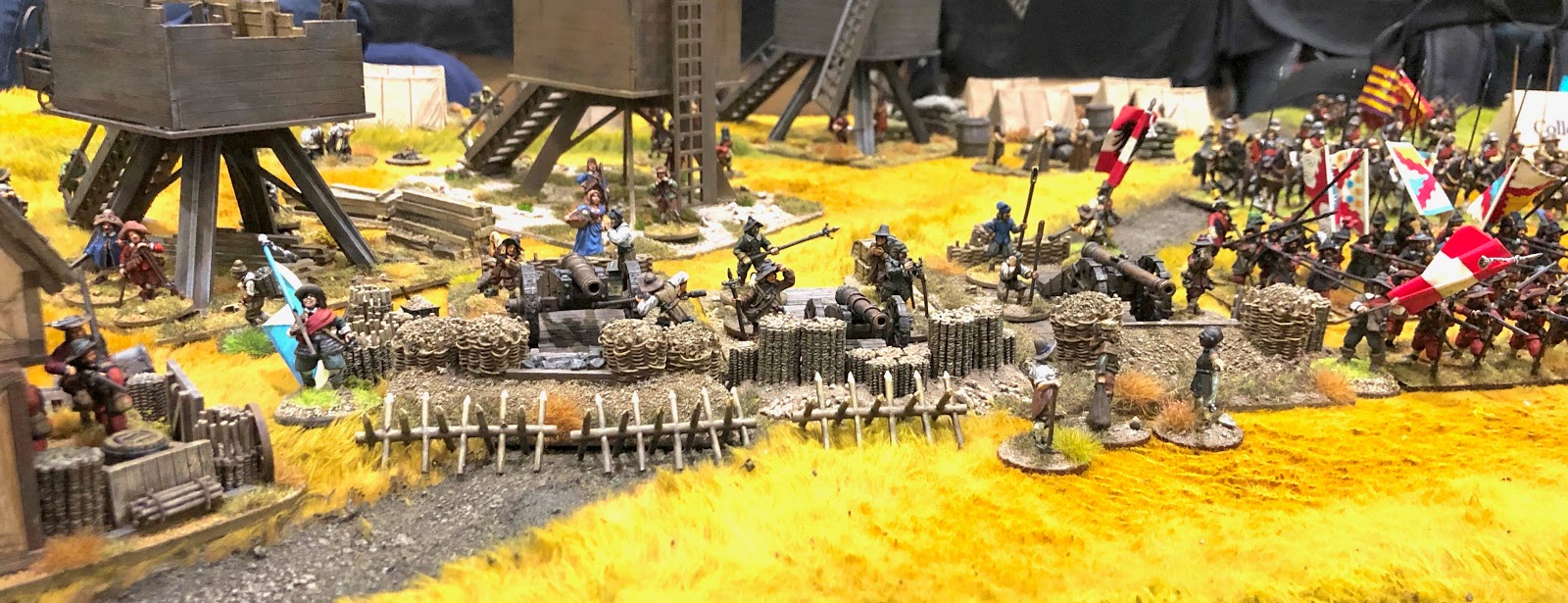
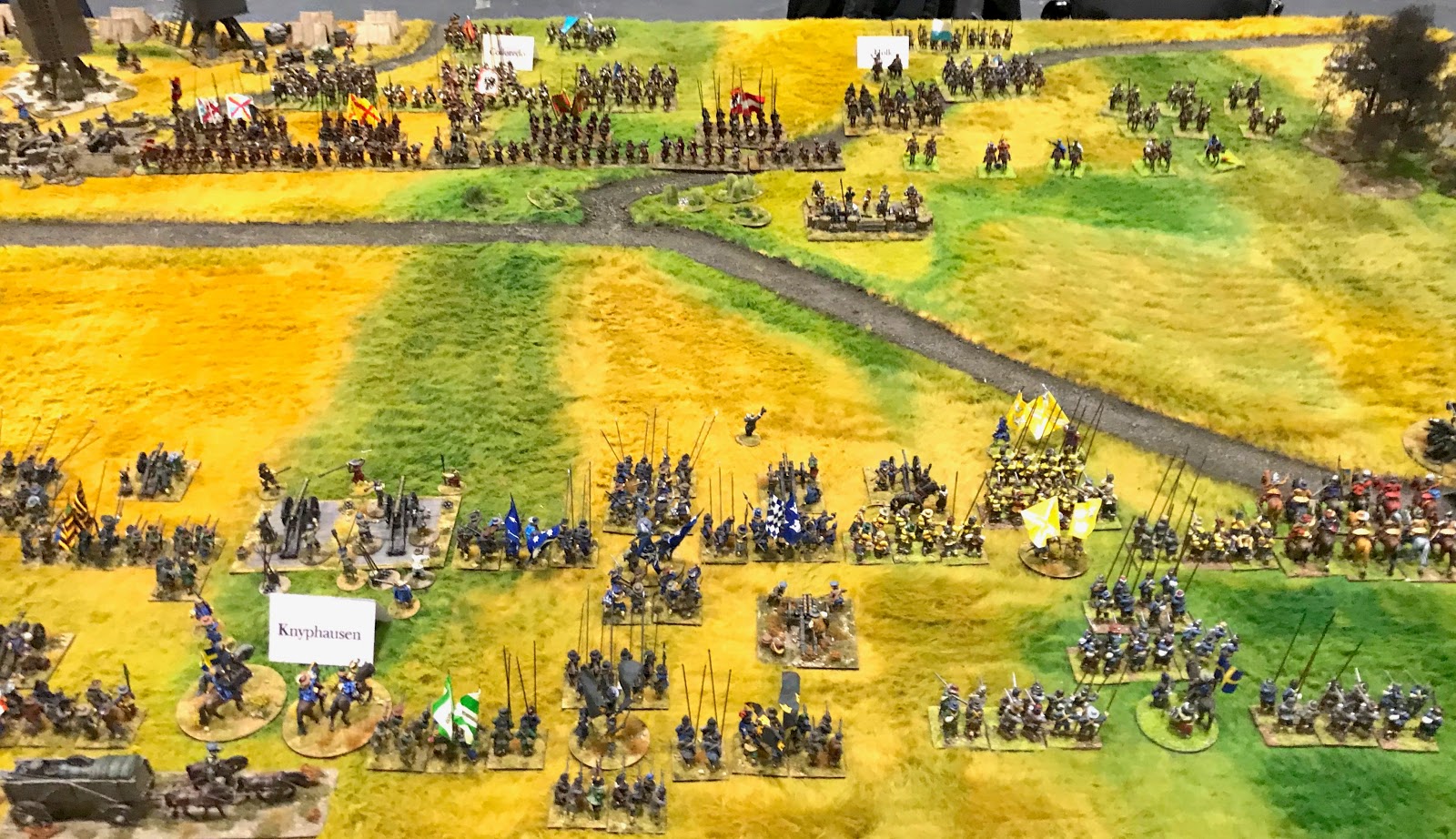
| The Battle of Dirschau / Tczew 1627 - initial deployment, taken from the Swedish, NE corner of the table. |
Looking back through the blog I can see that it was the start of June 2019 that the first germ of an idea formed to move my 17th century collection into Eastern Europe, following the demo of the Battle of Lutzen 1632 at Salute that year. So no awards for the fastest project to complete, that’s for sure!
Travel and Set Up
 |
| It all fits in the car! Just a small space left for over night essentials. |
Despite the long build up the final days and hours were still pretty hectic. It was a rainy day on the Friday before Salute when I had to load up the car, but everything fitted in, and there was still room for David K and I with overnight luggage. The journey was uneventful until the last 500 yds when it all got incredibly difficult. Getting to the actual entrance to ExCel was a nightmare due some major repair work that seemed to involve closing access roads. We eventually got into to ExCel and on to the show floor to unload but we’d lost over an hour with all of the extra shenanigans.
 |
| The bare table of gaming potential. |
While it would have been nice to have a quick cuppa after the long trip we were painfully aware that the show floor was being closed just after 4pm so we had to crack on. We soon had the terrain on the table and the dress rehearsal was definitely paying benefits in everything fitting pretty much as expected. We then started adding the the armies, but we had to leave the show floor before the armies were completely set up. We were still pretty relaxed as we would be able to finish off in the morning before the doors opened to the public at 10am. A relaxing evening talking gaming nonsense, and putting the world to rights, ensued.
 |
| The terrain down, just waiting for the troops. This is the edge of Dirschau itself, and the Swedish fortified camp. |
 |
| The terrain, from the Polish end of the table. Polish camp on the left, with the marsh and two crossing points in front of it. |
 |
| The approach to the town and Swedish camp. |
Saturday was a hazy, but dry start, and there was time for a quick walk along the dockside before the Premier Inn started breakfast. We were nice and early getting in to ExCel and we managed to talk our way in as I’d stupidly left our entry-to-the-show “wrist bands” in a bag under our table - doh!
 |
| Early Saturday morning - a bit hazy across the Royal Albert Dock. |
The Friends of General Haig was demonstrating two games at Salute and the other team were already busy setting up the Battle of the Berm, 1991, when we arrived. The last of the troops were soon on the table for Dirschau/Tczew and then it was time for my favourite bit of the setup; adding the civilians, camp followers, vignettes, and general ‘garnish’ to the tabletop. In a blink of the eye, and only a single cup of coffee, the game was ready and the rest of the FOGH demo team had arrived. We had five Friends on each of the two games which we hoped would mean there was enough people to keep the games moving, and also enough to engage with people looking at the game.
Other Games at Salute
In the last few minutes before the start of the show I managed to grab some time away from our tables to take look (and a picture) of two other games that I was really keen to see.
 |
| Simon Miller’s monster Ipsus game. Now that’s a phalanx! |
The first was unmissable, partly because it was next to our table, and also because it had two ginormous ancient phalanxes (2000+ pikemen I believe), over 30 elephants, scythed chariots, and hordes of cavalry and support troops all in 28mm and ready to clash in a test of ‘To The Strongest’ by Simon Miller. It was great to catch a few words with Simon and to swap some terrain ideas. His Ipsus game looked truly magnificent - the most pikey thing I have ever seen. It was a worthy winner of ‘Best 28mm Game”.
 |
| What two squadrons of Thirty Years War horse looks like in 28mm 1:1 ratio. |
The second game was one that I had been following in the build up to Salute on FaceBook. Steve Jones’ ‘Death Ride of Gustav Adolph’ in which two cavalry squadrons clashed at Lutzen 1632, in 28mm, at a 1:1 figure to man ratio. This was a brilliant game, not least because it looked awesome, but also because it was in effect a form of experimental archaeology; what did cavalry combat really look like? In our Dirschau game this clash would have been just two 12 figure units butting up to one another, and a fair bit of abstraction and imagination required to imagine the actual fight. In Steve’s game the whole chaotic maelstrom was brought to life. It was fabulous to meet Steve in person and we managed to grab a few very brief chats over the day to discuss 17th century cavalry combat.
Playing The Game
To read some background to the battle see the following page on the blog: https://theviaregia.blogspot.com/p/the-battle-of-dirschau-tczew-1627.html
The show opened at 10am and, as the crowds surged in to the show, we started the Dirschau/Tczew game with throws of the dice to decide who was commanding what. Sean and Simon ended up taking the Poles while David and Andy L took the Swedes. I bravely umpired (which was a very non taxing activity as the 4 Friends played with positive good humour through the day) and was also chief ‘chatter’ to interested passers by.
 |
| The table from the Polish, SW corner. Initial deployment. |
Following the experience of the dress rehearsal the Swedish players were coached to play aggressively and to take advantage of the Polish-Lithuanian forces being split across the marsh at the start of the game. David and Andy L took this to heart and sprung in to action, hurling the Swedish cavalry at the elements of the Polish cavalry who were isolated on the east bank of the marshes.
 |
| The village of Lunau ablaze, with the Swedish army deployed beyond it. |
 |
| The Swedish army deployed, ready for battle. |
A tough fight ensued with the few Polish cavalry on the east bank valiantly holding off the superior numbers of the Swedes, as more of the Polish cavalry struggled to get across the two bridges crossing the marsh. On this day of battle the Polish cavalry proved more than a match for the brave Swedes whose casualties were soon mounting alarmingly.
 |
| The northern crossing of the marshes being defended against the Swedish onslaught. |
[Note. I was so side tracked by talking to people during the game that I completely forgot to take pictures through the battle, so the pictorial record fails at this point.]
As described in my background to the battle (see link above) in this game we were combining the two days of the actual battle in to a single event. As the cavalry clash waned the Swedes brought up their three brigades of infantry in to the attack. The Swedish infantry came on very smartly at first but a ‘blunder’ by the left hand brigade broke up the formation some what.
The Polish cavalry had survived the battle with the Swedish cavalry with few loses and there were still more reinforcements crossing the marshes in support. The Polish cossack cavalry were able to advance and skirmish with advancing Swedish infantry and managed to further break up their formation. Some well timed hussar charges then halted the second Swedish attack.
We had reached about 4pm of the show afternoon by this point of the game and a quick check of overall loses showed that, with the latest infantry loses added to the earlier cavalry loses, the Swedish army had reached it break point. The game was therefore declared a Polish victory!
Thoughts On The Game
Putting on a wargame at such a busy show doesn’t leave any time for a debrief immediately following the game, but the long miles of the drive home, and subsequent chats with the team, have allowed some discussion about the game itself.
Overall the whole team were happy with the rules. We were using Warlord Games’ Pike & Shotte rules, with a small an amendment to the turn sequence so that shooting was carried out before command/movement. We’ve been using this for over a year now and we’re pretty happy with the change. (Interestingly, several people we spoke to over the day mentioned that they also play with this amendment.) The game moved along at a good pace, allowing for the necessary interruptions to talk to people interested in the game, and we only needed to refer to the rule book once over the day’s gaming.
Generally all the players were happy with factors we used for the different troop types in the battle, except maybe for the Polish Hussars. As the ‘poster-boys’ of the period they have a stat. line to match, and are both hard hitting and resilient. There had been some discussion with people watching the game suggesting that the Hussars should hit slightly less effectively after their initial charge as they will start to run out of lances. (The Hussar lances were hollow to make them light enough to wield effectively and so they easily broke on impact.) This would make sense but could need something to indicate when a unit has completed its first charge, which could be a faff to record.
The Hussars have not always been battle winners in games we have played and so I am not inclined to rush to ‘nerf’ them after one or two more positive run outs. Their reputation as powerful troops was also well attested in the period. Definitely something to keep an eye on though, as no one likes a super troop type that unbalances the game. I would be very interested in anybody else’s experience of using Polish Hussars under Pike & Shotte.
For those interested here are the force rosters we used, shared as PDFs on Google Docs.
Polish-Lithuanian Commonwealth: https://drive.google.com/file/d/130ZANmlofUpRK8tbVCSiwNGtvWktw1-Z/view?usp=drivesdk
The scenario seemed to work, with the Poles being hampered with their initial deployment, caught as they were with their forces on both side of the marsh. The Swedes were prevented from moving their infantry brigade for the first three turns, representing the time it took to deploy from their fortified camp. We didn’t get as far as either side trying to storm the opposing fortifications. Now I’ve got such plentiful earthworks it would be interesting to try some games with attacks on prepared defences. Perhaps a recreation of the actual second day of the battle with an attack by the Swedish infantry on the marsh crossing.
Thoughts On The Show
I’m sure that by now most people with an interest will have already watched and read plenty of reviews about Salute 50, but here is my take anyway! I’m not a great veteran of past Salutes, and have only visited a few times before, but I did think there was a very definite positive ‘buzz’ about the day, and this lasted through the whole day. At previous Salutes after an initial rush things have gone quiet by about 1pm or 2pm. On this occasion there seemed to be a lot more interest in people still looking around the games and wanting to talk right up until the end. We were still in deep discussion about the game and the finer points of teddy bear fur preparation right up to 5pm.
I was left with the feeling that the vast majority of people at the show were excited to be there, and wanted to engage with their fellow hobbyists. I found the whole show a very positive experience, and a great finale to the Dirschau / Tczew project. It was great to meet in person so many people who have become friends on social media.
Thank You!
A big thank you to the South London Warlords for putting on another superb show. From our point of view the whole team were helpful and supportive, and still had a smile on their faces as we drove off in to the sunset on Saturday evening. Great to see new things being tried at the show, and I hope Salute will continue to go from strength to strength.
All of the Friends of General Haig that were at Salute 50 want to say massive “thank you” to the many, many people who came and spoke to us and were happy to chat about the niceties of 17th century, or 20th century, gaming. Bruce (who put on the 1991 Berm game) and I are also very grateful, and humbled, by the lovely things so many people said about our collections and games. We are definitely bitten by the Salute bug, and we will hopefully be back. Not sure if it will be next year; maybe more than one year is required for a Salute project!
Until next time!
Andy @ The Friends of General Haig