Showing posts with label 1898 Miniatures. Show all posts

Tuesday, 18 July 2023

Rodeleros or Shield-Bearers

This post covers a new unit of pikemen for my Thirty Years War forces and includes a brief discussion of shield-bearers also known as Rodeleros, or sometimes as sword and buckler men.

28mm Imperial pikemen by 1898 Miniatures and Avanpost Miniatures.

I've been on a bit of painting hiatus since the preparations for Salute back in April. Most of my recent hobby time has been spent in research for potential new projects, but I have tried to keep some painting going as well. My Imperial forces are missing a few pikemen and so I have painted up a few bases using pikemen from the 1898 Miniatures and Avanpost Miniatures Thirty Years War ranges. 

Also in my pile-of-potential were some Avanpost 'sword and buckler' men that I have been looking for an excuse to use.

Background


The Spanish "Rodeleros", translating to "shield-bearers", seem to have started as a component of the Spanish infantry Tercios in the late 15th / early16th century.  The term "sword and buckler men" also seems a popular way to describe them. A small proportion of the Tercio would be armed with swords and small metal shields to try and break deadlocks when pike formations met.  They seem to have fallen out of fashion, perhaps due to their vulnerability to mounted opponents, and to have been replaced by halberdiers.  

A stylised picture of early 16th century infantry combat with rodeleros fighting through a pike formation in the centre.

By the Thirty Years War I'm not sure of evidence for separate formations of infantry with sword and shield. There seems to have been some discussion in the period of their use in support of pikemen, and of having the equipment to hand in the baggage to use when troops were called on to storm breeches etc.  It was also suggested that larger metal shields would be able to protect pikemen from the shooting of musketeers, but I'm not sure of any evidence that this was tried. 

Detail from The Battle of Kirchholm (1605) by Snayers - officers with shields at the front perhaps?

The wonderful Kadrinazi blog by Michal Paradwoski (here) points out some figures in the Battle of Kircholm by Snayers that are carrying shields.  The unit represented is part of the Swedish army and Michal wonders if Snayers may have been using his knowledge of Imperial infantry for inspiration here. 
 

Shield Bearers


Sword and shield armed soldiers also appear in 17th century contemporary art in association with the colour parties of infantry formations.  I assume that their role was to defend the colours.  This was probably partly ceremonial as well as functional.  

Shield bearers lead the formation of the Cracow Militia on the Stockholm Roll

Two shield bearers are typically shown with their swords drawn so that they are always ready for any danger that threatens their formation's colours.  

The Night Watch by Rembrandt.  Can you spot the two Shield-Bearers?

Detail from The Night Watch of one shield bearer.

Detail from The Night Watch of the other shield bearer.

Even one of my favourite 17th century pictures includes these shield bearers!  Perhaps not at first obvious but the two shield-bearers are in the picture, carrying their shields, and with their swords drawn as expected with the company's colour on show and therefore in need of protection.

Forming The Unit


At least two 28mm Thirty Years War ranges include shield-bearers or 'sword and buckler' men: Warlord and Avanpost.  When Avanpost released their figures I had ordered some due to the very nice sculpts.  As I was selecting figures for the pike unit I was reminded of these figures and so decided to add them in as 'interest'.  It is also worth noting that Avanpost and 1898 scuplkts fit together very nicely.

Pike with command group - command group 28mm Avanpost.

When the pike unit has a command stand placed in the front it looks like the shield-bearers are there ready to defend the ensigns carrying the colours. 

Pike unit with included shield-bearers.

Without the command stand the shield bearers provide some added colour.  

Close up of the shield bearer.

The other shield bearer in a nice burgonet with shoulder armour in addition to the back and breast plates.

I like the 1898 Miniatures pikemen sculpts in the rest of the unit as they are in a really nice variety of slightly relaxed poses; here looking like they are 'catching their breath', adjusting their equipment, as they prepare for the next assault.   


I would be very interested to hear what other people think about Rodeleros, or shield-bearers, in the Thirty Years War period. 

Until next time!

Andy @ The Friends of General Haig.

Monday, 15 August 2022

More Swedish Cavalry

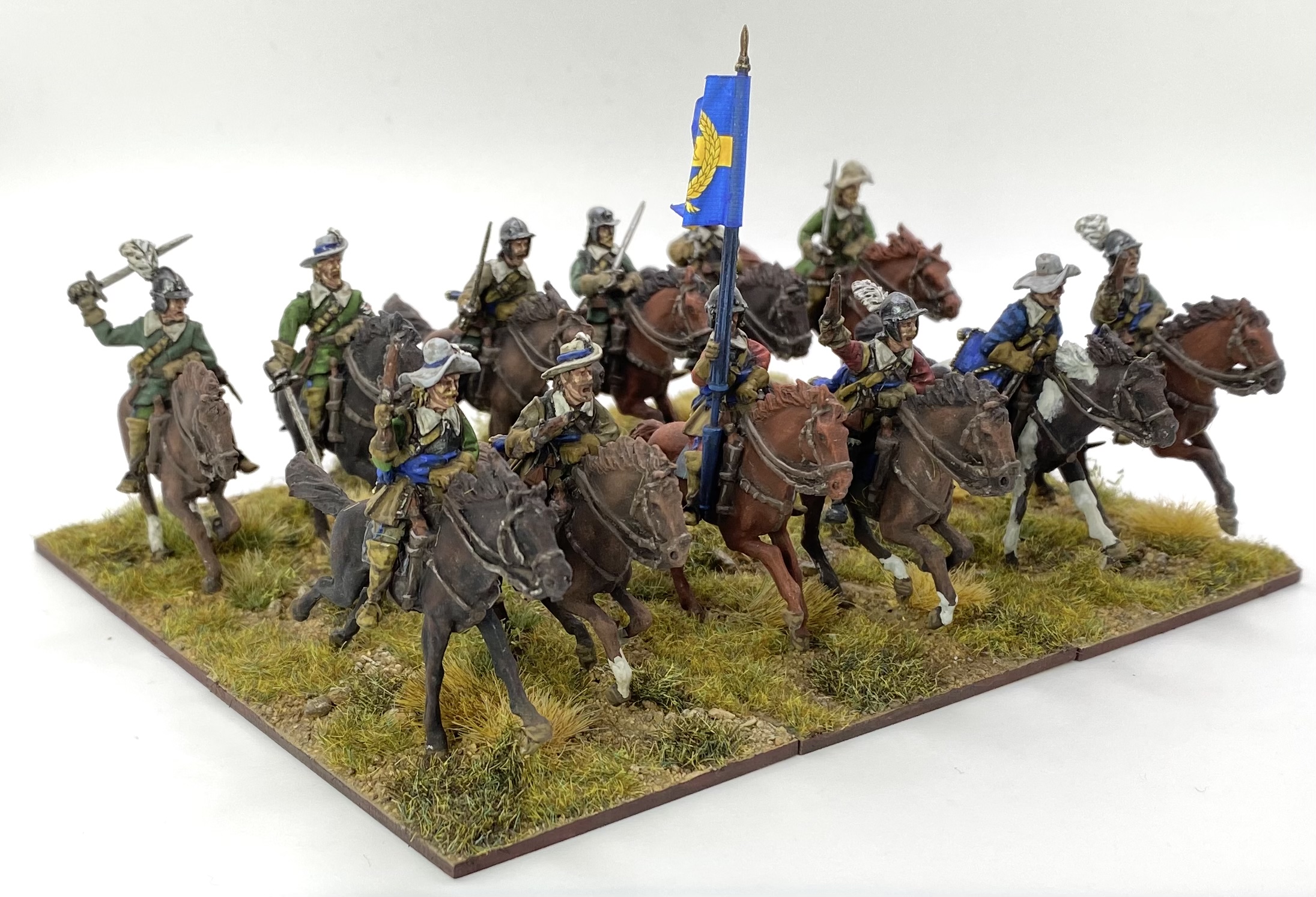
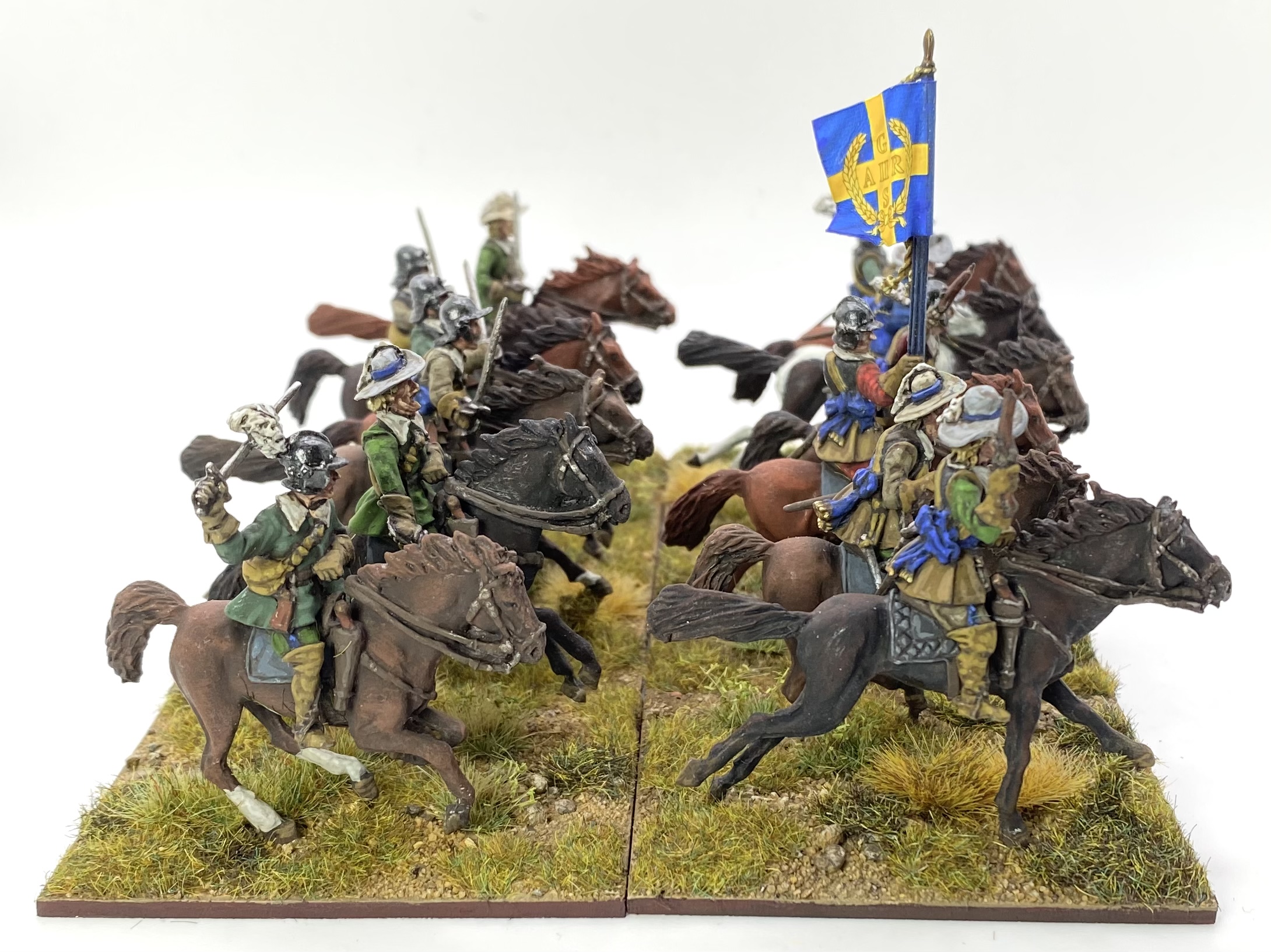
In this blog post I look at the latest unit from my painting table. A unit of 28mm Swedish horse, for my 1620s/30s Gustav Adolph army, using 1898 Miniatures’ Thirty Years War (TYW) range.

28mm cavalry from 1898 Miniatures’ ThirtyYears War range.

I completed my first unit using these figures back in February (see link) and covered the 1898 recent figure release then. This new unit was approached in a similar way. 1898 released nine packs of cavalry, each of three figures.  I bought one of each pack, and so this new unit was built using the remaining figures (with three left over that will be used to accompany the 1898 TYW general figures that are in the ‘pile of opportunity’). 

As with the previous unit I have kept with the front rank holding pistols and the second rank with drawn swords, following Gustav Adolph’s instructions for how the Swedish horse was meant to attack.  The first rank was to only fire at point blank range, and the following ranks to fall on directly with cold steel.

I had used the one command pack on the previous unit and so for this unit I needed some slight conversions. I used the cavalry cornet pole arm and trumpeter’s arm from the Warlord plastic cavalry box which fitted the 1898 figures with a minimal amount of filing and green stuff.  

The cornet is again from Mikhail Betski, at MB Creation, and I have also again used the colour of the flag to influence the scarf/sash colour, this time having them a royal blue colour, fringed with yellow.  At this period, my understanding is that, there was no standard sash colour used by the Swedes and I tend to switch between blue, green and yellow as fancy takes me, these colours at least contrasting with the Imperials’ red sashes.

I gave the unit a green theme, painting their riding jackets in different shades of green, with a few sleeveless buff coats in the front rank with the better equipped men.  I also gave the trumpeter a pie-bald horse, after reading that this was popular with the Swedes in this period, when appropriate horses were available. 

These were a bit of a slog to get through and I’m blaming that on the summer weather!  Next up on the painting table is the start of a unit that I have been looking forward to painting for a long time.

Until next time!

Andy @ The Friends of General Haig 

Sunday, 27 February 2022

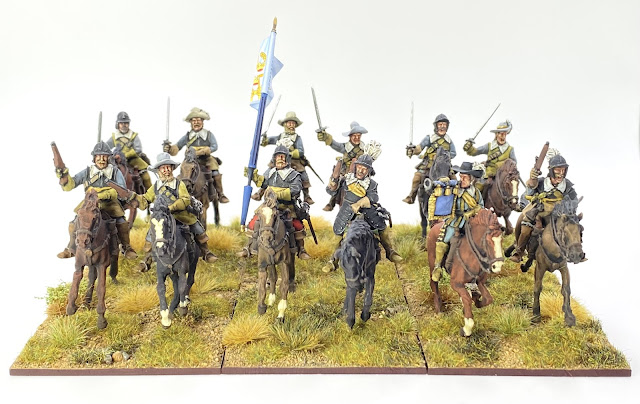
Thirty Years War cavalry from 1898 Miniatures

In this blog post I look at the latest Thirty Years War (TYW) release from 1898 Miniatures; the Cavalry.  

Thirty Years Wars Cavalry from 1898 Miniatures - 28mm

The post is broadly split in to three parts: a description of the figures, how I found preparing and painting them, and finally the first unit that I have built using the figures. 

The Figures. 

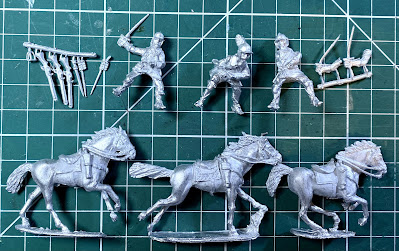
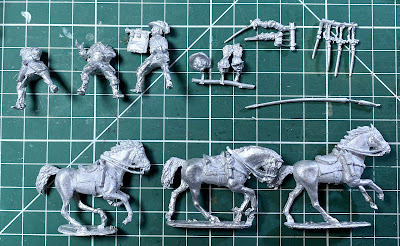
1898 released these cavalry at the end of 2021, adding to their existing range of infantry and generals for the period. There are nine packs in this release that include armoured and un-armoured riders, wearing helmets or broad brimmed, soft hats, holding pistols or swords, as well as a command pack. Each pack contains three different rider figures which means that you have a lot of variety available. There are three different horse sculpts across the rank and file packs, and the horses in the packs with pistol armed riders have one pistol missing from the saddle holsters which is a really nice touch. 

Contents of a typical cavalry pack

The command pack contains an officer, a trumpeter and a cornet / standard bearer. There are head options for the officer and cornet, and arm options for the officer as well.

Contents of the command pack

Each pack includes separate scabbards and carbines to be glued on to the figures. For figures holding their sword the scabbards are empty, and for figures holding a pistol the scabbards have the sword sheathed. Another nice touch.

The riders fit on to the horses very easily with the saddle sculpted on to the horse rather than the rider. The horses themselves are well proportioned with the bridle and other tack nicely detailed on the models. The horses are in active poses either cantering or galloping. In addition to the riders’ animation, this will give a great impression of attacking cavalry.

The resulting figures represent the classic early to mid 17th century harquebusier type cavalry. The rider’s armour is mainly limited to back and breast plates, with the occasional figure having some arm protection as well. Helmets are either of the burgonet or single-barred Dutch pot variety although the helmeted packs include a tiny three-barred face plate that you could add to one of the figures to turn the helmet into a three-barred English pot.

They are modelled wearing a buff-coat although this could sleeved or sleeveless depending on how you paint them.  You could of course paint them as wearing riding coats and not buff coats if you choose. Many, but not all, have a scarf/sash, so necessary in a period when cavalrymen of this type looked very similar in all armies.

Figures wear leather gauntlets and have their swords suspended either from a cross belt or waist belt.  All of the figures have a cross belt on their right to which you attach the carbines. The figures have powder flasks hanging from this cross belt as well.

The figures retain the sculpting style of the infantry. Nicely sculpted, with lots of detail, and every figure has bags of character. I think they really look the part of figures for this period, and with the variety of different rider figures available, you can make a very varied looking mounted force.

Building and Painting

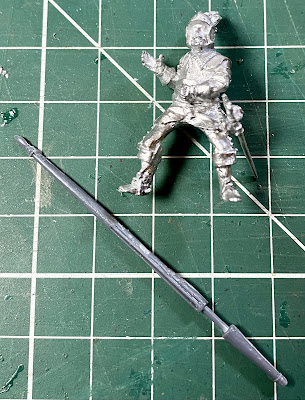
The figures come with minimal chipping and filing required. There are some tiny burrs from the casting process, and minor mould lines to be filed.  The metal is the softer style of white metal rather than the stiffer more brittle style of some manufacturers.  Some of the horses have only two contact points with the base and so are at risk of bending at the ankles if roughly handled. I haven’t had any accidents with horses actually breaking off the base, which I think is thanks to the more forgiving, bendy metal.  Where riders’ right arms were not positioned quite to my liking I was able to gently bend the arms in to slightly different poses. 

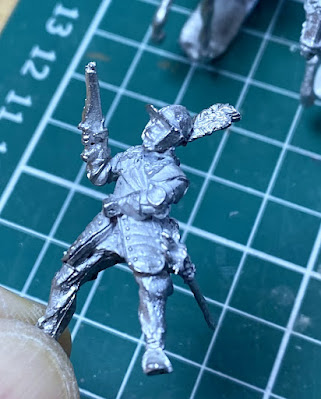
With at the very least a separate scabbard required to be added to every figure, there is some assembly required.  The scabbards can be a little fiddly and so super glue with a spay can activator is definitely your friend at this point. Some figures have a separate right arm that helps add further variety to units and these glue on quite easily.

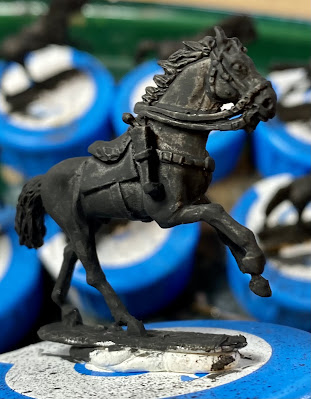
Primed horse figure

Once primed the figures are a joy to paint.  The detail is perhaps not as prominent as say a Bircorne or Bloody Miniature figure, but I didn’t have any trouble using my normal methods including washing and dry brushing.

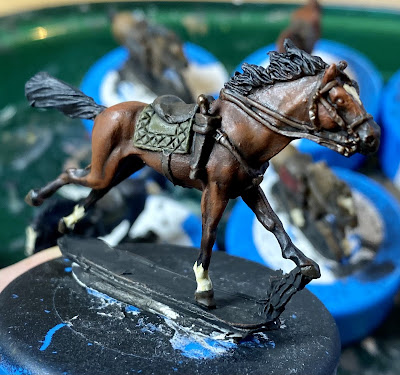
Horse following base coat, dry brush highlights, tack etc. painted, overall wash, and blaze/socks added.

My First Unit

With the style of the figures being quite animated and, to me aggressive looking, I thought they would  work really well as Gustav Adolph’s Swedish Cavalry.  From the late 1620s the Swedish cavalry were adopting a doctrine of being more aggressive and saving firepower to use in close quarter fighting.  Gustav Adolph issued orders that the first rank of cavalry should attack with pistols, that were to be fired just before impact, and the second and subsequent ranks were to attack with swords drawn.  

With the variety of pistol and sword armed figures available, I decided to have a front rank with pistols and a rear rank with swords. Swedish cavalry were often short of armour and so I had the front rank all armoured, and the rear rank mostly unarmoured.  

Officer with right arm, head and scabbarded sword glued in place.

As part of reducing his horseman’s reliance on firepower, Gustav Adolph also took carbines away from his cavalry units. This would mean I didn’t get to use the nice separate carbines provided for the figures, and also means that the right hand cross belts on the figures are unnecessary. However I can live with this slight oddity that I suspect the majority of people will never notice! 

Cornet / standard bearer with Warlord plastic ‘lance’.

The cornet / standard bearer is provided with a white metal ‘fluted lance’ to carry a flag. I can never get on with white metal pole arms as I find them difficult to keep straight.  I therefore replaced this with a Warlord plastic fluted lance.  (There is one on every Warlord cavalry plastic sprue and so I have lots of spares!)

I painted the horsemen mostly in sleeveless buff coats and gave them varieties of  grey for coats and breeches. Sashes / scarves were painted yellow.  There doesn’t seem to be a clear sash colour for the Swedes at this time and so the choice was as much aesthetic as historical. Armour was painted black, and broad brimmed hats were mainly lighter greys that seem to have been favoured by the Swedes. 

The unit was finished with a cornet / flag from Mikhail Betski at MB Creation, a supplier I’ve only recently come across, who provides some really nice flags for this period. I used the colour of the flag to influence the colours for the trumpeter’s clothing as unit’s musicians were often expensively dressed by the unit’s officer as part of the military fashion of the time.  

In conclusion, I think the new 1898 TYW cavalry figures are a great addition to their range, and a great resource for all those collecting 28mm armies in this period. All of the 1898 figures have a particular style, but will still work well with other manufacturers. I’m really pleased with the unit I’ve built with them and I will be adding a few more in due course. 

The next figures on the table will be some Polish civilians and another general stand for the Poles. 

Until next time!

Andy @ The Friends of General Haig 

Wednesday, 21 April 2021

Casualties of War

This blog post shows a new set of stamina markers created using casualty figures from 1898 Miniatures, and counter bases from Warbases.

Casualty figures from the 1898 Miniatures Tercio range - 28mm

One piece of record keeping that is required for Pike and Shotte games is to keep a note of a unit’s loss of stamina points. You can do this with a small dice, but I find that these either get knocked over as figures are moved about, or that the dice get picked up by accident and used for other rolls!  I am therefore a fan of using these counter bases from Warbases (link).  I have used here the 40mm “Style 2” option.  These are ideal to fit a 28mm figure which I think improves the look of a bare counter.

 I was therefore delighted to see that 1898 included a ‘Dead and Wounded’ pack in their Tercio range (link).  Having recently painted up a few units of shot from this range (see here link) these casualty figures were ideal to use with them on the tabletop.  In line with the rest of the range, the casualties are single piece, 28mm castings, some of which require the addition of a scabbard to the figure.   

Rear view of the casualty bases.

There are six figures provided in the 1898 Dead and Wounded pack, although two of them are provided as a single piece casting.  I really like the poses of the figures as there are two or three that provide a nice change from the standard dead figure lying flat on the ground. I really like the wounded solider being helped by his comrade, and the wounded officer preparing to defined himself. 

Top down view showing the numbers.

The figures were nice to paint up, and have enough detail to take washes. 1898  have a useful painting guide for the Tercio range on their site (link) that, as well as showing the overall technique, also has a handy table of the Vallejo colours that provide the ideal muted colour palette to represent the typical 17th century solider on campaign. 

I hope  you have found this blog post useful, and you feel inspired to create some of your own casualty markers.

Until next time!

Andy @ Friends of General Haig (FoGH).


Wednesday, 17 March 2021

Foot Command Bases

This post covers a new approach I am taking in my 17th century armies to how I represent my infantry units, and in particular the command figures for these units.

28mm Figures from 1898 Miniatures (command stand), then a mixture of Warlord metal and plastic musketeers.

First of all, it is probably worth saying, that this has nothing to do with the requirements of one particular ruleset, nor is it about making anything ‘more historical looking’. It is about making the miniatures look good, to me, on the table top, and also about making units flexible to use in different formations.

Background 

Up to now my foot units have typically had one base within the unit that includes the ensigns or standard bearers. In a period with either no uniforms, or what uniforms there were being vaguely understood now, it is often the unit’s flags that gives the strongest indication of what the unit is trying to represent. Also, I think flags look really good and so try to have two of them in most units. Along with the two standard bearers I typically include an officer and musician (most often a drummer) on the base. The officer’s sash can also suggest a particular historical force (although not as often as we’d hope).  Therefore you can see that by changing this single command base you can swap the unit for use in a different army. 

A regular Pike and Shot unit. Note the command base in the middle.

My basing system for foot figures is to use four 28mm figures on a 40mm square base.  This system, with my approach to command bases, means that three bases makes a nice central pike block; two bases of pikemen either side of a central command base. The full regiment or battalion therefore looks like this.

New Requirements 

More recently I have been looking at representing formations that don’t fit this approach, such as the Swedish brigade formation that Gustav Adolph used for his Swedish infantry. I’ve also been looking to experiment with other rule systems, some of which use the whole unit frontage as a measure in the game, that means this 360mm (9 bases each of 40mm width) wide formation isn’t very convenient. If I was able to have the command base outside the regular rank and file bases then it would make it easier to change units about.

Half-hex, 2mm thick, MDF from Warbases.

A solution to this was suggested when I looked at some of Barry Hilton’s units on the League of Augsburg site (link). Barry sometimes uses a base that sits in front of the rank and file bases.  I have seen he has used half hex shaped bases in some cases, and I think this looks quite neat. So, a brief email exchange with the ever helpful Warbases resulted in me receiving some half-hex 2mm thick MDF bases. These are 80mm point to point.

Here is my first new style command base.  These figures are from 1898 Miniatures ‘Tercio’ range (see previous blog post here for more details on 1898). The flags are slightly modified from Flags of War.


Command base - 28mm from 1898 Miniatures, ‘Tercio’ range.

This base can be placed at the front of a unit.  The idea is that it doesn’t count as part of the actual unit for the purposes of the game - it is just there for show.  

New system command base leading the unit.

It can also be placed behind units such as when the unit is in combat. 

Command base at the back of the unit - smaller unit with 6 bases.
Here are some more pictures of formations showing how the new command base will fit in.  I think it provides a flexible way having different formations and still have the command base ‘look right’.

Command base with a 3 base unit.

Command base with a two base unit.

Leading column of march.

Interesting option for ‘Charge For Horse’.

I am pleased that this experiment seems to have worked out.  I will build my command bases like this going forward.  I want to try it in some games (when we can do those again!) and if it still seems like a good idea then I will consider going back and rebasing some of my old units.

As well as 1898, I have also been painting up some figures from another smaller TYW manufacturer. These will have to wait for the next blog post.

Until next time!

Andy @ Friends of General Haig.