This post looks at the start of a new unit for my 1620s/30s Swedish army; the Yellow Regiment.
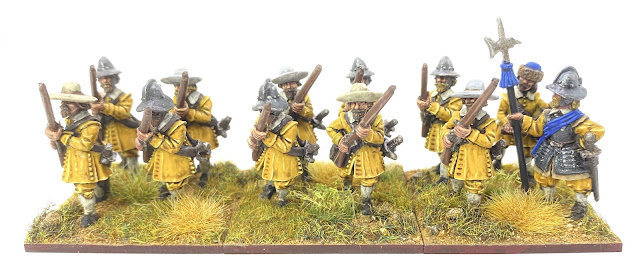 |
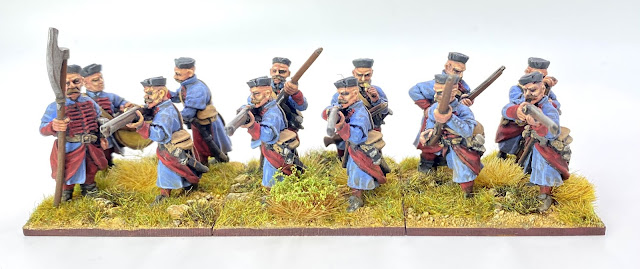
| Swedish Musketeers advancing, 28mm from The Assault Group (TAG) |
“A great body with yellow casacks came up resolutely in formation and with pikes covering their musketeers.” Giulio Diodati, Imperial Quarter Master at Lutzen 1632.
Brief Background
The ‘Yellow Regiment’ was the short-hand or nickname for Gustav Adolph’s Household Regiment that evolved from the Drabant Guard of his father and grandfather. (It was still properly referred to by the current Colonel’s name.) During Gustav Adolph’s reign the regiment went through several evolutions. It was always expected to serve on active service, and was often heavily engaged in the action. They were certainly not a formation only used for palaces and parades! Calling them ‘Yellow’ may actually have followed them being given yellow uniforms in the mid 1620s, and their colours/flags then followed suit in being yellow as well. (For more general discussion about the Swedish ‘Colour’ regiments and brigades see this previous post
https://theviaregia.blogspot.com/2020/11/old-blue-and-other-colours.html .)
When I first started collecting Gustav Adolph’s Swedish army the only unit I already knew about was the famed ‘Yellow Regiment’. Surely a striking spectacle for the miniature battlefield. Now, fours years later, I am finally starting to paint it. I suppose a simile for this would be collecting a Napoleonic French army and finally starting on the Old Guard. Or collecting a German army for WWII and finally getting some King Tigers. So, it feels like a momentous milestone to have reached.
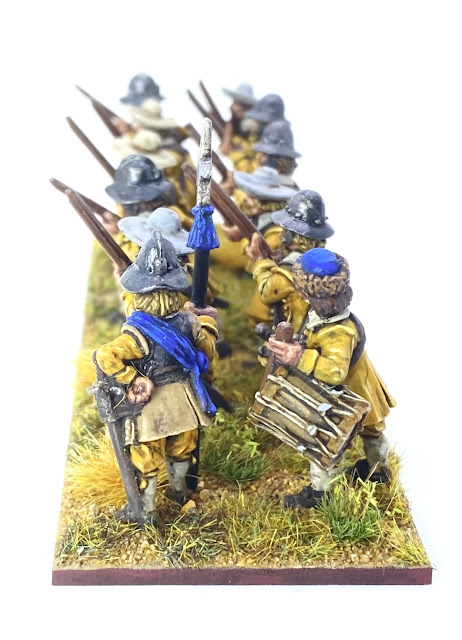 |
| This sleeve of Muskets has integral command with a sergeant and drummer from the TAG command pack |
Saving the best ‘til last
Why has it taken me so long to get around to this iconic unit? Two reasons. The first is down to one of the first ‘how-to’ books I read about wargaming, Bruce Quarrie’s Napoleon’s Campaigns in Miniature (still an excellent intro to the Napoleonic period, just perhaps skip using the rules!). In this book Mr. Quarrie advises on how to go about collecting your chosen army. He suggests painting a regular Napoleonic ‘line’ infantry unit before every other type of unit. So, for example, paint a line unit, then an artillery battery, then another line unit, then a light infantry unit, then another line unit, then a unit of cavalry, then another line unit, and so on. This means you’ll end up with the majority of your army being line infantry, but you’ll always have something different to paint next to keep your interest going. Mr. Quarrie goes on to suggest that even within this process you should leave the guard until last. His logic is that when you start off painting you will not be as competent as you will be after a dozen or so units. You want your guard to look their best, and so don’t start them when you’re still ‘getting your eye in’, so to speak.
I still follow this guideline today. I try to vary units in my painting queue, even within the same army, to keep the painting mojo going. I also try to avoid rushing in to those special / favourite units. The Swedish Yellow Regiment was therefore something to be saved, and savoured.
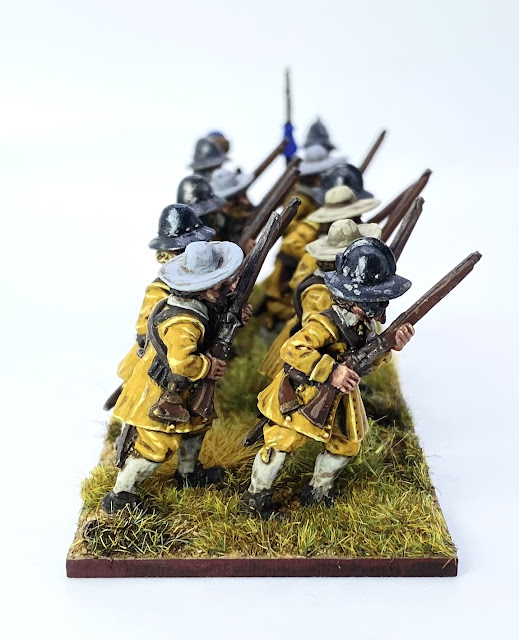 |
| I like the pose as the musketeers appear to be purposefully advancing on the enemy. |
“Yellow is capable of charming God.” Vincent Van Gogh
The second reason for me taking so long to get to the Yellow Regiment was the colour; the dread ‘yellow’. As someone who undercoats in black, or at least very dark paint, I have always struggled with achieving good yellows. This isn’t too much of an issue normally where just the odd accent on a figure has to be yellow, but having the whole figure’s uniform being yellow made me hesitate. I have watched many videos now on how to paint yellow on figures, many of which have been about some outfit called ‘The Imperial Fists’ who even in the far, far future find yellow an ideal colour to wear on the battlefield. (They are obviously fine soldiers with impeccable taste!). I have tried the undercoat in pink technique, and I have tried many brands of yellow paint, all marketed as giving excellent coverage, but none seeming as wonderful as promised. In the end it has come down to following the adage of Duncan ‘two thin coats’ Rhodes, and realising you often need multiple coats of some colours, and to let them dry between coats.
I wanted the Yellow Regiment to have a distinctive look, beyond the yellow uniforms. I decided to have them looking quite uniform and smart in appearance, as befits the Household regiment. I chose to use the Swedes in cassocks from the The Assault Group (TAG) range. I’m not convinced that this style of buttoned cassocks was worn by the whole regiment, but they are very nice figures and they will stand out from my other more rag-tag Swedish units. (I understand that Gustav Adolph did order a batch of longer coats for his troops in the 1620s while fighting in Prussia, so it is possible that his own regiment may have been clothed in something like this coat.)
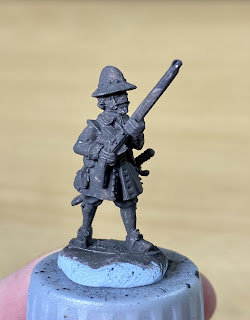 |
| Figure primed in dark brown |
 |
| Base colours applied |
 |
| Wash applied |
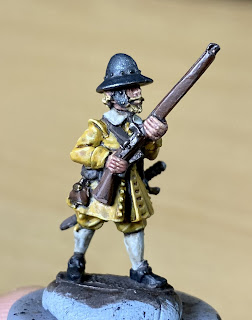 |
| Highlights applied - ready for varnishing |
Practice
For this first unit of the Yellow Regiment I started by painting just one figure as a test. I followed my current, normal approach. Brush on prime in a dark brown. Next base colours blocked in, followed by a wash. Finally highlights to taste. Happy with the test figure I then cracked on with the rest of the unit.
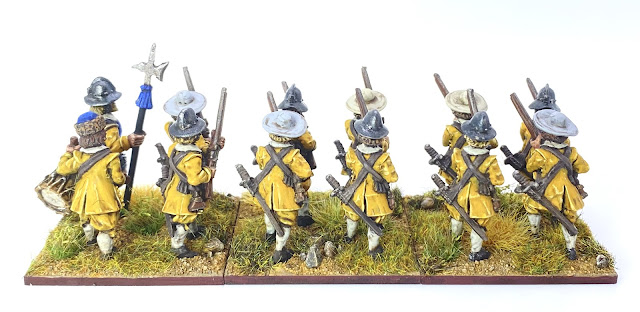 |
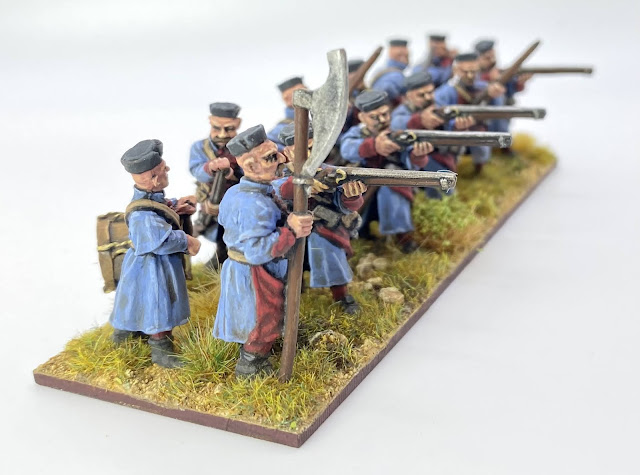
| The rear of the unit. |
One down …
The first component part of the Yellow Regiment complete is this ‘sleeve’ of shot. They were surprisingly easy to paint as it’s unusual for me to have such a uniformed unit (I’m normally trying to represent the rag-tag appearance of troops on campaign).
One thing with having such a distinctive unit is needing a suitable casualty marker. Sadly there are no wounded/dead TAG figures to match the unit and so I used this Warlord casualty figure.
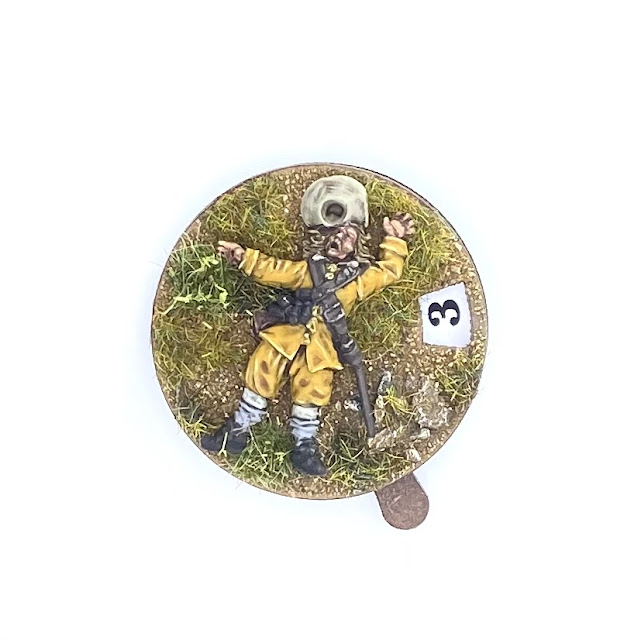 |
| Warlord casualty on a Warbases 40mm ‘counter’ base. |
Perhaps some pikemen next.
Until next time!
Andy @ The Friends of General Haig.