Showing posts with label Bloody Miniatures. Show all posts

Sunday, 26 May 2024

Clowns to the left of me. Jokers to the right.

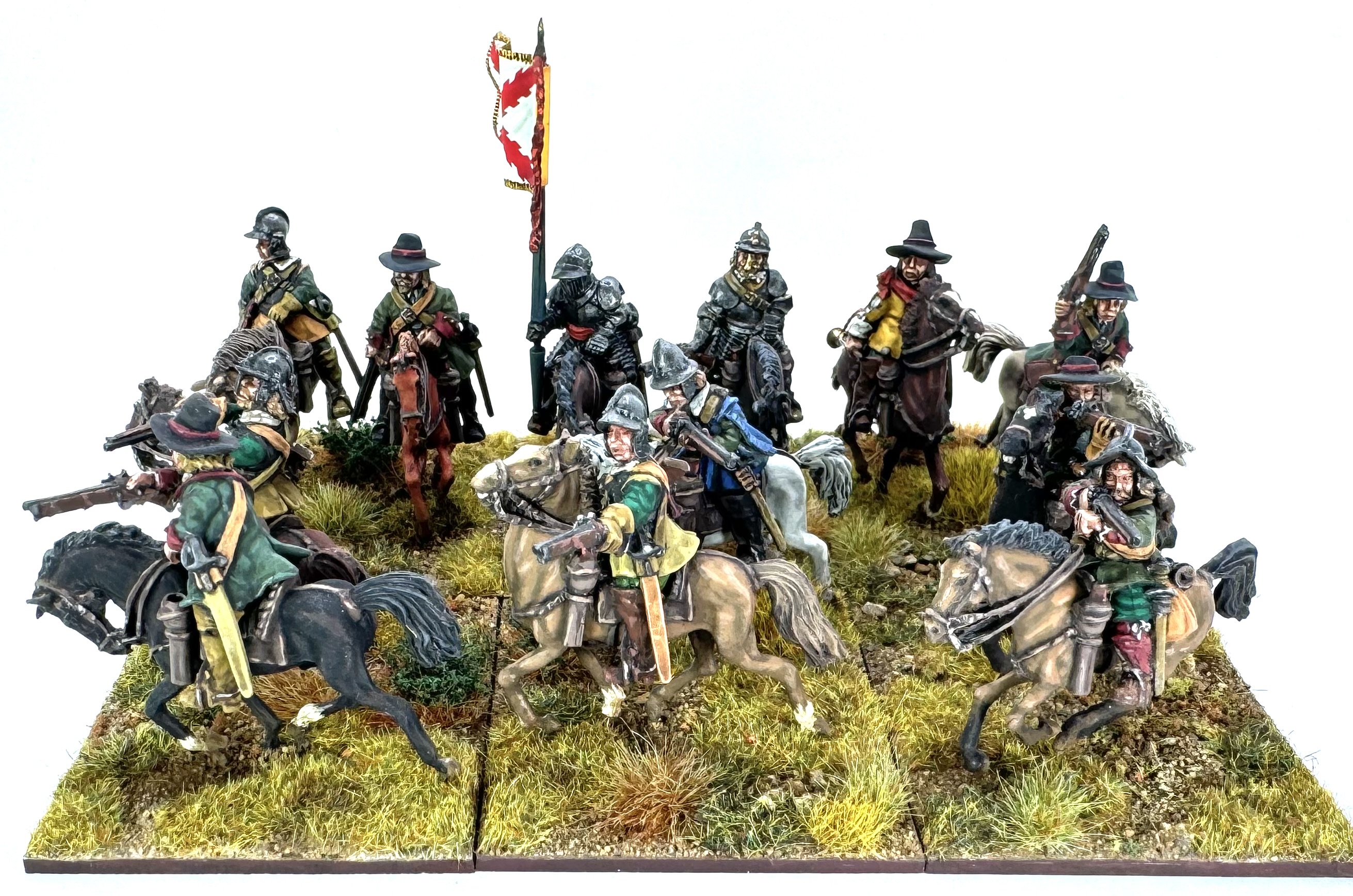
This post looks at a new unit of Harquebusiers for my Imperial Thirty Years War and Polish-Lithuanian armies.

28mm Harquebusiers, mainly from from Bloody Miniatures, with a couple of Warlord and TAG, perform a ride-by shooting manoeuvre. 

This unit started around an idea I had to try and use figures in a pose that I have always found challenging to use; the "shoot the guy next to me" pose.

28mm Harquebusier from Warlord Games in the dreaded 'shoot the guy next to me' pose.

The Pose

Figures in this pose exist in many periods, and from many manufacturers.  I have never been clear how sculptors have expected gamers to use these figures.  In the 'olden days' of figure ranges having maybe only one or two figures for a troop type, then this pose could be hideously limiting.  Imagine a whole unit, ranked up, of figures in the pose above; not a good look!  Even nowadays, with broader ranges of figures, the one or two figures in a pack that are shooting to the side have been left at the bottom of my 'pile of potential'. 

In a recent trawl through my collection of riders I came across the rather sad collection, right at the bottom of a box, of all these 'shoot the guy next to me' rejects.  I was considering that these would be a great entry to Wargamers' Room 101 (see Yarkshire Gamer's podacst for more details on Wargamers' Room 101) when a thought struck me; "What if I made up a unit of just these figures and used the pose as a feature?".  If I based the figures so it looked like they were riding by the enemy, while shooting at them, it might just work.  

Shooting From Horseback

So, how did horsemen shoot from horseback in the 17th century?  You don't have to look through too many contemporary battle pictures to see mounted horsemen shooting every which way. I had a look through the 'Militarie Instructions for the Cavall'rie' by John Cruso, first published in 1632, and thought to be the manual used most readily by inexperienced officers in the British Civil Wars who were trying to read-in to their new roles as war broke out.  Despite Cruso providing almost excessive details on how to load pistols while mounted, he provides little details on how to fire them.  

Picture from John Cruso's Militarie Instructions for the Cavall'rie

His only digram showing how to 'give fire' shows the classic posture for firing a pistol forward.  Cruso later mentions that horsemen should be able to fire to the left or right.  He also mentions that some other manuals recommend being able to fire to the rear, but rather dismisses the idea as not being terribly useful (perhaps thinking it is better to focus solely on getting away from trouble!). Perhaps there is something behind figure manufacturers continuing to turn out figures in poses shooting to the side after all.

Illustration by Graham Turner in Osprey Warrior series 'Ironsides - English Cavalry 1588-1688' by John Tincey.

Graham Turner's fabulous picture of a horseman giving fire to his left, whilst resting his carbine on top of his bridle arm (the arm with which he holds the horse's reins), shows a classic pose described in Robert Ward's 1639 book 'Animadversions of Warre'. Ward advise that Harquebusiers should strive to have their enemies on their left so they can use this posture to give fire with their carbines. 

The Caracole

If an individual horsemen could be expected to give fire to any quarter then how did this work for formed bodies of horsemen. Just about every book about warfare in this period tells us that cavalry were trained to fire rank by rank in something called a Caracole. The first rank would fire their carbines or pistols forward at the enemy, and then retire to the rear of their formation to reload, while the next rank came forward and repeated the process.  Once this constant fire had broken the enemy's resolve then the horsemen would draw their swords and charge home to complete their victory. However it is not clear if the rank by rank fire by horseman is what the term Caracole refers to.  

More pictures from Cruso. This is the start of the 'Carracoll'
where the defenders have split to allow the chargers to pass between their two bodies.

Second of the Cruso 'Carrocall' pictures in which the chargers have been thrown into confusion and are now trapped, at the mercy of the two bodies of horse. 

Back to Cruso who describes the "Carrocall" as a completely different manoeuvre in which charging enemy cavalry are defeated by the defenders splitting in two, to the left and right of the chargers' direction of travel. As the hapless chargers career through the gap, they are fired on from both flanks, and then charged in the flanks/rear.  This all sounds terribly tricky to execute, but doesn't sound anything like rank by rank firing. 

Cruso and Ward both mention firing by rank, then wheeling to the left or right to retire to the rear, but do not refer to it as a Caracole.  It is interesting that Cruso advises against this rank by rank fire if you are likely to be charged as he says you will be thrown in to confusion through the rearward motion of some of your own troops. The left wing of the Parliament cavalry at Edgehill obviously did not take this advice! 

Caracole is meant to derive from the Spanish word for 'snail' that is caracol.  I don't see a connection between rank by rank fire and snails (especially as this same rank by rank fire on foot is not described as a Caracole). 

The Battle of Fleurus 1622 by Peter Snayers - Rijksmuseum

Peter Snayers' famous painting, now thought to be of the Battle of Fleurus in 1622, in the middle distance shows a large Protestant cavalry formations, riding across the front of enemy Spanish infantry, exchanging fire, in what looks very like the curl of a snail's shell.  Is this a Caracole?  Snayers' painting also shows in the left foreground a shell-like 'circle' of Spanish horse pouring fire into another formation of Protestant horse that are falling in to disorder while Spanish infantry and artillery also add to their discomfort.  

The exact meaning of cavalry performing a Caracole remains unclear to me. What does seem clear is that 'ride-by shooting' (to mix in modern terminology!) was seen as a typical cavalry function, and this could take multiple forms on the battlefield. 

Forming The Unit

With all of this information and uncertainty swirling around my mind (rather like a cloud of confused horsemen in a Peter Snayers' painting!) I started to hatch a plan for using the previously rejected figures in a unit.

Trial set-up of the figures - front rank in ride-by shooting pose (Caracole?), second rank ready to support.

I put together some of 'shoot to the left' figures, together with their horses, and started to experiment with some potential formations that I could use to show the unit in the act of firing on the enemy while riding across their front.  I finally landed on a single rank in the ride-by shooting pose, backed up by a rank in normal poses, which to me looked like they were ready to start their own shooting once the front rank had retired to the rear.  I had been prepared to adopt a wider than normal unit frontage but as it turned out my standard 25mm per horseman frontage seemed to work ok if I accepted a rather haphazard and perhaps unsafe looking formation.  (Anyone who feels this looks far too chaotic should take a close look at the Snayers painting - there is a fabulously detailed version available of Wikipedia link.)

A whole lot of shooting going on!

This approach to forming a unit had the added benefit in that it allowed me to use many of the Bloody Miniatures recent mounted release in a unit, with a sprinkling of Warlord (and I think TAG) figures from the reject box. Some small conversions were required, such as to get a suitable Cornet and Trumpeter figure, as well as making the Warlord/TAG figures fit neatly on the Bloody horses. As with all of the Bloody Miniatures I have had so far, these were a joy to paint. 

Front rank blazing away while the second rank advance,  ready to add their own firepower, or perhaps charge home if the enemy seem to be wavering.

The resulting unit works for me, although I'm sure it will confuse people as to which way the bases are meant to face when being moved about on the table. It was exciting to read in a recent Bloody Miniatures newsletter that there are more mounted figures coming soon.  I am now almost hoping for more 'shoot the guy next to me' figures to be included in the release!

Flag from Flags of War Thirty Years War range.

The Captain and Cornet have invested in 3/4 armour.

Warlord riders on Bloody Miniatures horses. One in the Robert Ward pose, and one not.  

Bloody Miniatures, with the addition of the ever useful trumpet-hand from the Warlord plastic Pike & Shotte cavalry sprue

A Bloody Miniature and TAG riders on Bloody Miniature horses.

Bloody Miniatures doing some shooting.
The rear shot. 

I hope that my journey through old military manuals and paintings will help inspire anyone else out there with a sad collection of neglected figures who are in tricky poses.  Try some alternative basing to get those figures where they belong - on to the table.  They will almost certainly be quickly ridden down by hard charging Royalists, Swedes, Poles etc. but at least they will look a bit different. Better than being stuck in a formation with clowns to left, and jokers to the right, both shooting at you! 

Maybe the new unit will not have to use its casualty marker first time out, but I doubt it very much.
Casualty figure from Bicorne Miniatures, and counter base from Warbases. 


Until next time.

Andy @ The Friends of General Haig.

Friday, 16 February 2024

“Mighty fair description of men without horses …”

(A quote from MacIntosh, played by Burt Lancaster, in ‘Ulzana’s Raid’. The quote has no relevance other than describing mounted warriors being on foot!)

28mm figures from Bloody Miniatures

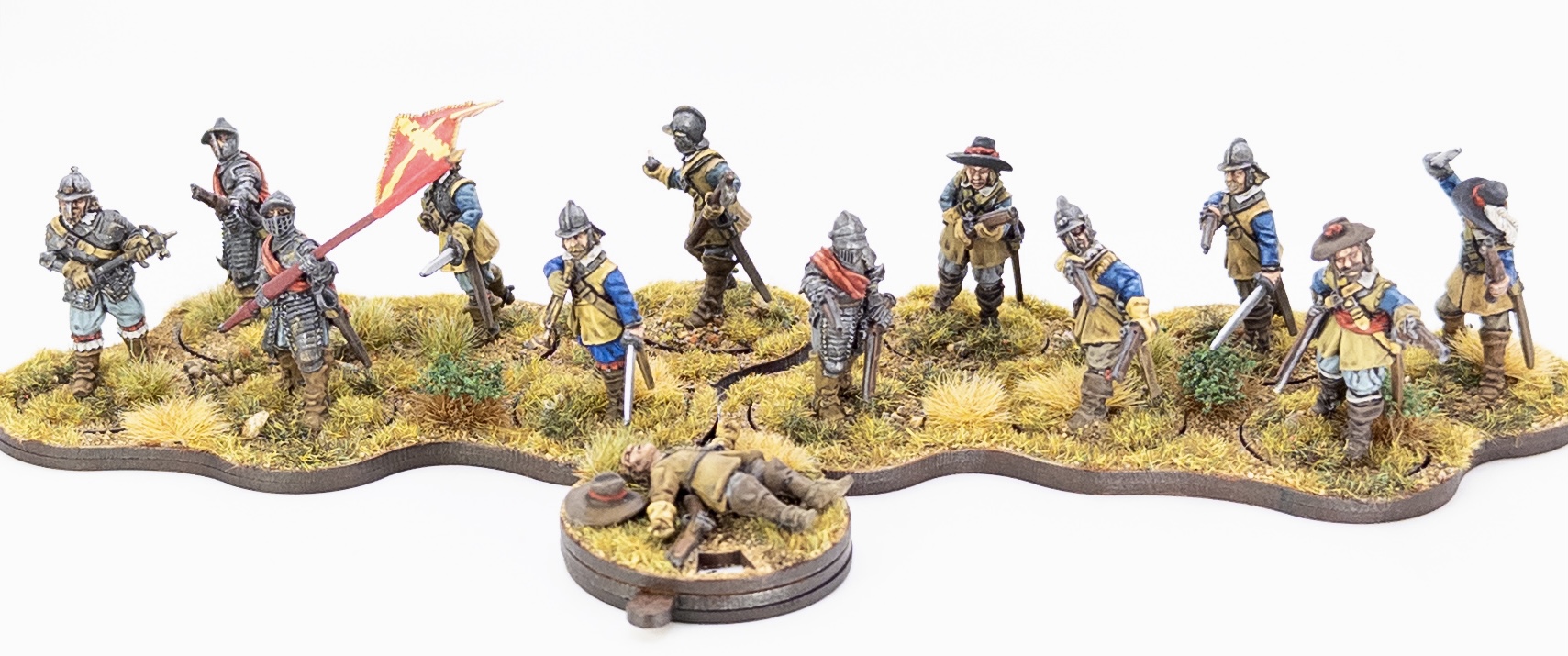
This post looks at the latest unit coming from my painting table; a unit of dismounted Polish Rajtar (Reiter) for the Khotyn 1621 campaign.

Inspiration 

The inspiration for this unit was two-fold. Firstly I was looking for a reason to paint another batch of the stunning Bloody Miniatures that have been accumulating in the pile-of-opportunity.  They really are a joy to paint.  Secondly I was inspired by reading about the actions at Khotyn in September 1621.  As the month went on the assaults and sallys that took place became more and more desperate.  Much of the fighting involved the storming and counter-storming of the Polish defensive earthworks. Every available soldier was required in these actions and this led to both sides dismounting their horsemen to add to the fighting strength.

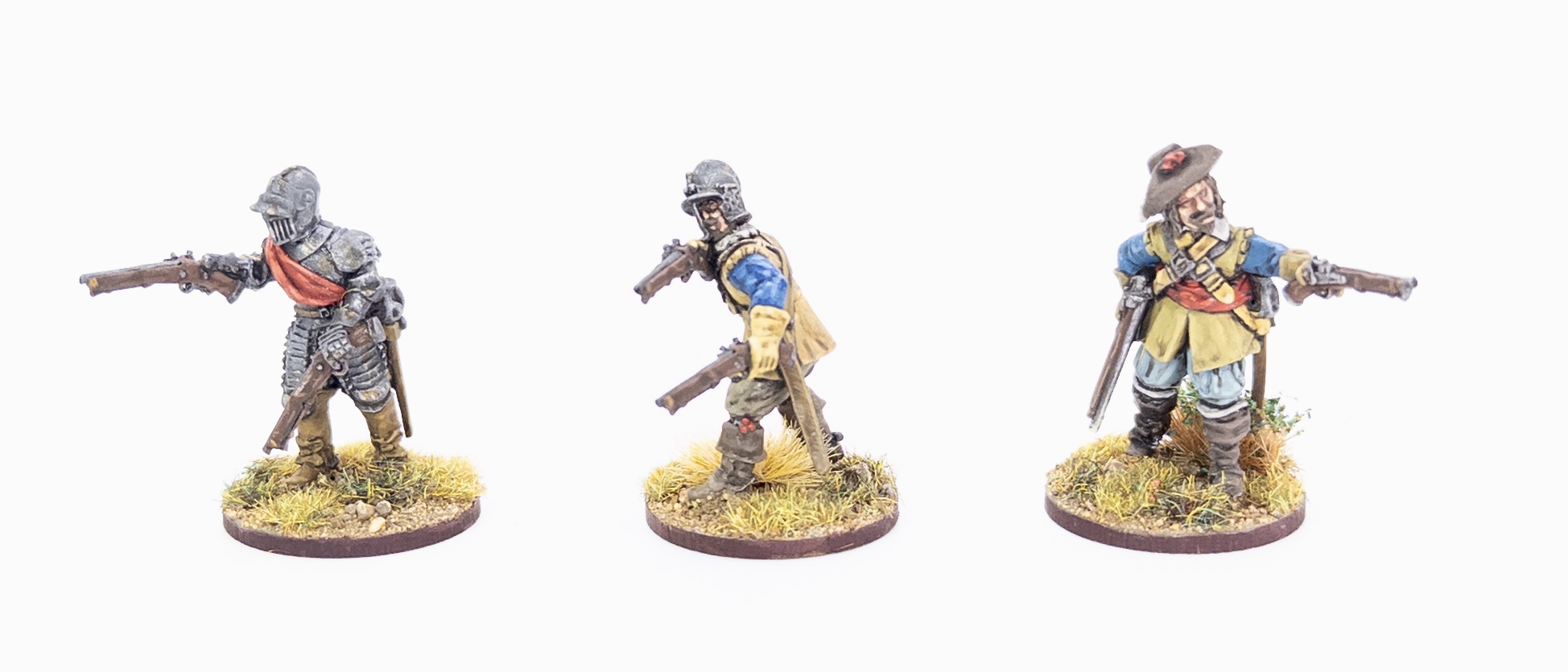
The command party with officer, cornet and trumpeter.


Horsemen, but on foot

The dismounting of cavalry to storm, or defend, fortifications in this period  was fairly common. Their armour, firearms, and more elite status no doubt added to their effectiveness in the role. I have used a mixture of Bloody Miniature figures to form this unit, including figures in three-quarters (or cuirassier) armour, back and breast plates with buff coats, or just buff coats.  To add to the dismounted horseman feel I also chose figures in the long bucket-top boots, a definite period indicator of a rider. (If dismounted troops had the choice then this form of footwear would not have the been the best choice for clambering over earthworks, or to aid agility, but let’s say they had not brought spare shoes with them!) 

Some handy options for fighting in fortifications: armour, extra powder and grenades!


Building the unit

The Rajtar units in the Polish-Lithuanian Commonwealth armies were typically recruited from Germany.  They probably wore a mixture of armour, based on what they could afford and personal choice.  I also avoided three barred ‘English Pot’ helmets to keep the continental feel.  The only light conversions needed were to make a trumpeter and a cornet to carry the troop’s colour. These were fairly straightforward.  The trumpet came from a Warlord plastic cavalry sprue. (I’m not sure that dismounted troopers would have bothered with a trumpet and their cornet/colour in this more brutal and disorganised fighting ‘in the breech’. However, it was fun to show these types dismounted as well.)

Making the most of cavalry short range firepower


Painting

I painted the troopers in fairly neutral colours, with a vague blue theme based on nothing more than personal choice.  I have shown the buff coat wearers in sleeveless buff-coats, for this earlier 17th century period, by painting coloured coat sleeves.  Scarves (sashes) and other clothing accents were painted red / scarlet to help tie in with an Imperial theme, in case I want to use the unit in my Wallenstein Imperial army for Thirty Years War battles. Red is also nice colour accent against the dark, greyish armour and blue, grey clothing. The cornet/colour is from the Flags of War Imperial Thirty Years War range, with some battle damage added.

With carbine, swords and pistols.


Basing

The figures are based individually on 2 pence piece size bases and I have made up some sabot bases as well (all from Warbases).  This gives a suitably pell-mell feel to a unit that will be required to carry out some desperate actions in difficult circumstances, as well as in difficult terrain. I included a casualty marker on a Warbases 40mm counter base. The casualty is from the Bicorne ECW range. His discarded pistol is from the Bloody Minis spare equipment packs, and his lost hat is from the ‘spare bits’ box. 

Casualty from Bicorne Miniatures, on a Warbases counter base.

Khotyn 1621 Project Update

In other Khotyn 1621 project news, I have been researching the Ottoman army and buying a few figures to investigate options and possibilities. Thank you to everybody who has made recommendations.  So far I have selections of figures from Warlord Games, Warfare Miniatures, The Assault Group (TAG), Perry Miniatures, and Fireforge Games, as well as some 3D prints from various designers all printed by the super-helpful Paul at Sabotag3D Wargames Accessories.

The whole outfit - in their sabot bases (also from Warbases).

Book Competition Winner

Regular readers will remember that in the previous post (here) I offered a copy of Michal Paradowski’s Khotyn 1621 book from Helion as a prize to a commenter on the post (on any of the social media channels in which it appeared).  The commenters were added to a spreadsheet and a winner was chosen at random.  Many congratulations to Danny Buck who commented on Twitter.  You can see Danny enjoying his book below, and you can follow him on Twitter / X here: @DannyBuckUEA  

Many thanks to Michal for providing the book as a prize, and also many thanks to all of the commenters who took part across X, Facebook, TMP, LAF and here on Blogger.

Dr. Danny Buck with his prize! 

The next unit on the painting table should be Ottoman, and I look forward to discussing my initial choices in figures and paint schemes in the next post.


Until next time,
Andy @ The Friends of General Haig. 


Wednesday, 14 April 2021

Those Bloody Miniatures!

This blog post takes a look at minis from a new figure producer, Bloody Miniatures. 

A first command group created using the new range from Bloody Miniatures - 28mm

Bloody Miniatures (link) is a new figure producer that has just released (March 2021) their first range of miniatures.  These are aimed at the War of the Three Kingdoms (English Civil War) and the Thirty Years Wars.  The initial release contains four packs, each of four different figures and is focused on equipment and poses especially suitable for forlorn hopes, storming parties and other smaller ‘actions’.  The figures have been sculpted by Nick Collier, who Bicorne and Renegade fans may remember was the designer for those early ranges. In common with Bircorne etc. these are on the larger side of 28mm figures, and are supplied in one piece metal castings (the figures armed with pole arms have separate weapons).  

I was lucky to spot the announcement of the Bloody Miniatures range on Facebook on the release day.  I was so impressed with the pictures that I immediately ordered all four packs. The figures arrived in a couple of days and were very nicely boxed.  I especially liked the red tissue paper used in packing which goes well with the company name! 

The figures are really nice sculpts, with lots of crisp details.  This initial release are great representations of dismounted cavalry and infantry equipped for close quarters fighting.  This makes them ideal for smaller skirmish games, or as specialist assault units in larger games. I have chosen to make some slight conversions to the first four on to my painting table as a command group.

The first four figures from Bloody Miniatures on my painting table

The ensign with the red colour (above) is supplied with a polearm, so I have simply swapped this for a flag.  I added a drum from my bits box to the carbine armed figure to represent a musician who has slung his instrument and is getting ready to get stuck in.  I didn’t change the sword and pistol armed figure. The ensign with the yellow colour has had his, previously empty, left hand drilled out to accept a flag staff, and I also added a hat, also from my spares box, as he was bare headed and I wanted a more formal look.  (Flags from Adolfo Ramos, link.)

I based these figures on individual, round bases, as I intend to use them in either skirmish games or as lose formation troops in games of Pike and Shotte. I normally use UK two pence pieces (2p) as bases for this type of figure as there are the perfect size, the weight helps balance metal figures and they are magnetic for helping with storage.  Due to ‘the event’ I no longer seem to have a supply of 2ps.  Over the last 12 months I have used up my own stock, as well as raiding the children’s piggy banks etc. I have therefore fallen back on Warbases round, 2mm deep, MDF bases with a 5mm hole (link, and then go to custom items to order the holes link).  Warbases do these in exact 2p diameter size, which is great, and with the addition of a 5mm diameter, 2mm deep rare earth magnet, the bases are also magnetised for storage.

A custom 2p movement tray from Warbases to take 2p bases

You can see from above that I’ve also taken this a step further.  Warbases made me some custom 2p movement trays, also with holes for 5mm magnets. These are 70mm in diameter with space for three bases.  These are a great way to add some flexibility to your collection; you can use figures individually when necessary, and also multi base for convenience. Two tips. You can get different size magnets but I have found 5mm the best to allow for the weight of a 28mm metal mini. Secondly, when using magnets in the tray, and on the figure base, then polarity becomes important.  When gluing the magnets in you’ll need to check that the polarity matches with the rest of your collection.  I keep one of my completed and magnetised bases handy to use when deciding which way round the magnets need to be placed in new bases.

The movement tray with figures added.

In conclusion, this is a fantastic start from Bloody Miniatures.  The figures are a joy to paint; very characterful, and with clear details.  There are a few figures wearing triple bar lobster pots that I will probably restrict to representing troops in the British Isles,  but the rest of the figures would be at home in any conflict in the first half of the 17th century.  I understand that the first release was so successful that the initial stock sold out in a couple of days!  There has since been a re-supply and I would heartily recommend these figures to anyone using 28mm figures in this period. A new release is planned for later this year, and I am really looking forward to it - I’m sure it will be something out of the ordinary, and very desirable! 

Until next time!

Andy @ The Friends of General Haig (FoGH).