Showing posts with label cuirassier. Show all posts

Friday, 21 October 2022

Heavy Horses

This post looks at the latest unit on my painting table, a unit of Cuirassiers for my Swedish army of the 1620s. 

28mm Avanpost Cuirassiers.

This is the second unit that I’ve created using Avanpost’s 28mm resin figures (see the previous one here: https://theviaregia.blogspot.com/2021/06/ake-totts-cuirassiers.html).  I’m not very confident about the longevity of these rather fragile figures but they are lovely to paint! 

After seeing someone else’s unit with different finishes of 17th century cuirassier armour (hello to Paul Mackay on Facebook!) I decided that I would have a go at a mixture of armour finishes.  I have also always liked the Angus McBride illustration in the Osprey Elites title on English Civil War Cavalry that shows Haselrigge’s lobsters with three types of armour finishes. Untreated metallic armour would have rusted very quickly and so metal armour typically had some form of protective patina added. 

Base coat of mixed gunmetal, black contrast and blue metallic.

Dry brush of steel and dark wash applied.

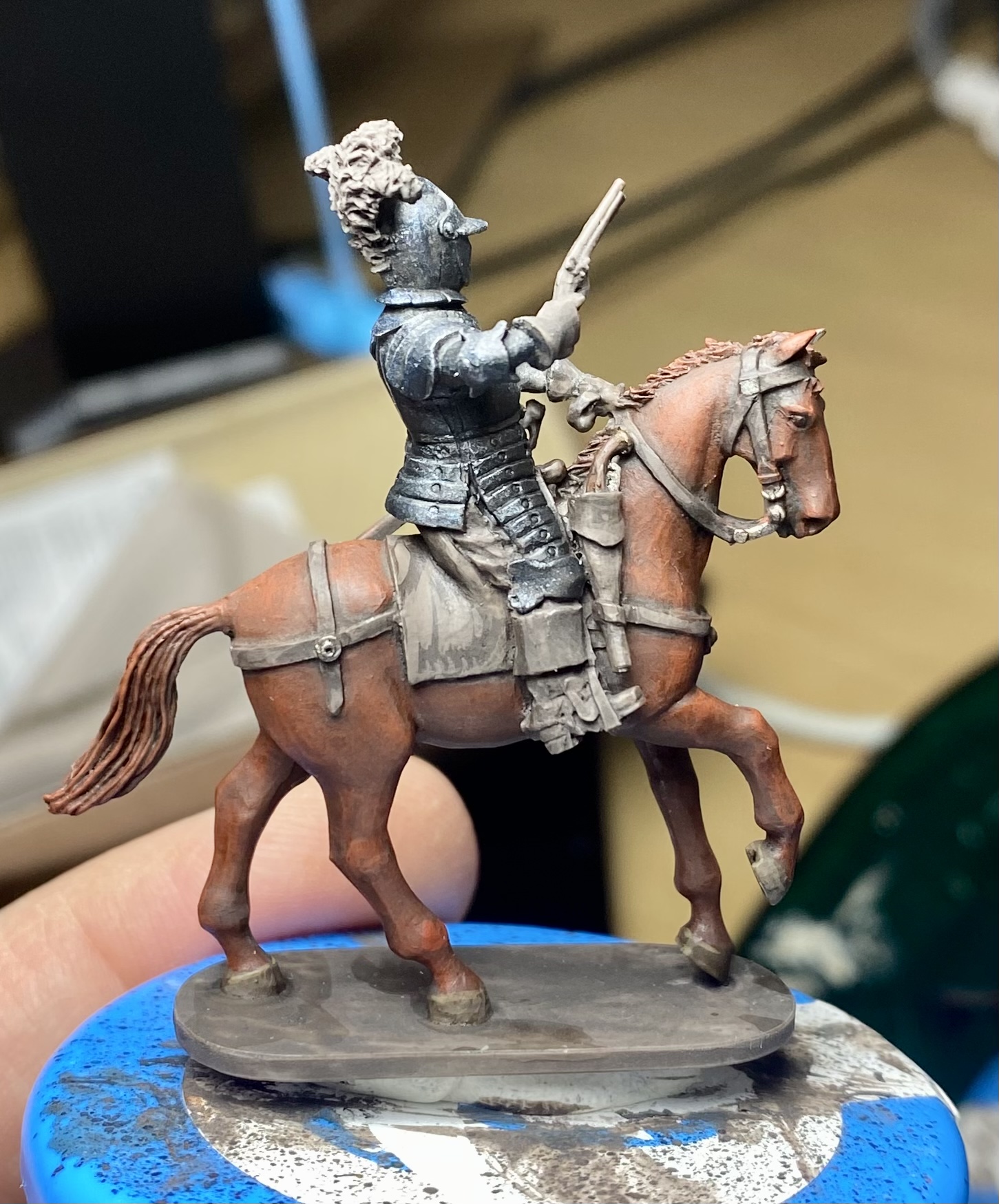
Blackened armour was probably the most common (and cheapest) finish and this could be achieved by coating the heated armour with linseed oil and soot. To achieve something like this on my miniatures I used a base coat of equal parts of GW Leadbelcher, VMC Blue Gunmetal and GW Contrast Black Templar. Over this a dry brush of GW Ironhands Steel, and then a final wash of thinned GW Nuln Oil.  By adding more of the Blue Gunmetal in the base then a bluer finish can be achieved which was a considered a more desirable, and expensive, finish in the 17th century. 
Base of gunmetal, washed with red-brown contrast.

Dry brush of steel added. 

Russeting was another patina finish which gave a reddy-brown finish, and was most popular in the 16th century.  One 17th century recipe I’ve seen for this suggested oil and vinegar. To represent this I used a base of Leadbelcher with a ‘wash’ of GW Contrast Fyreslayer Flesh. Finally a light dry brush of Ironhands Steel. 
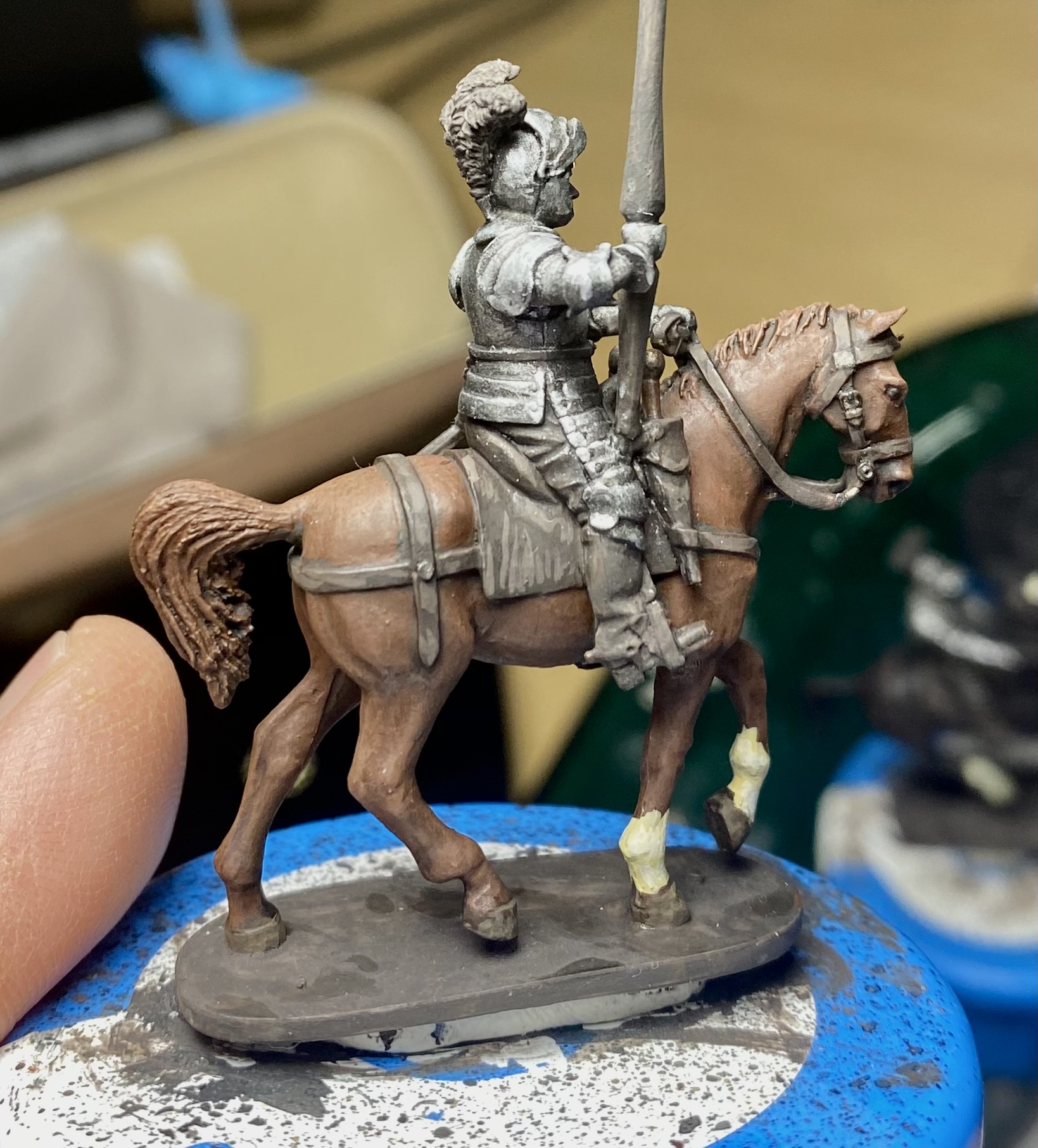
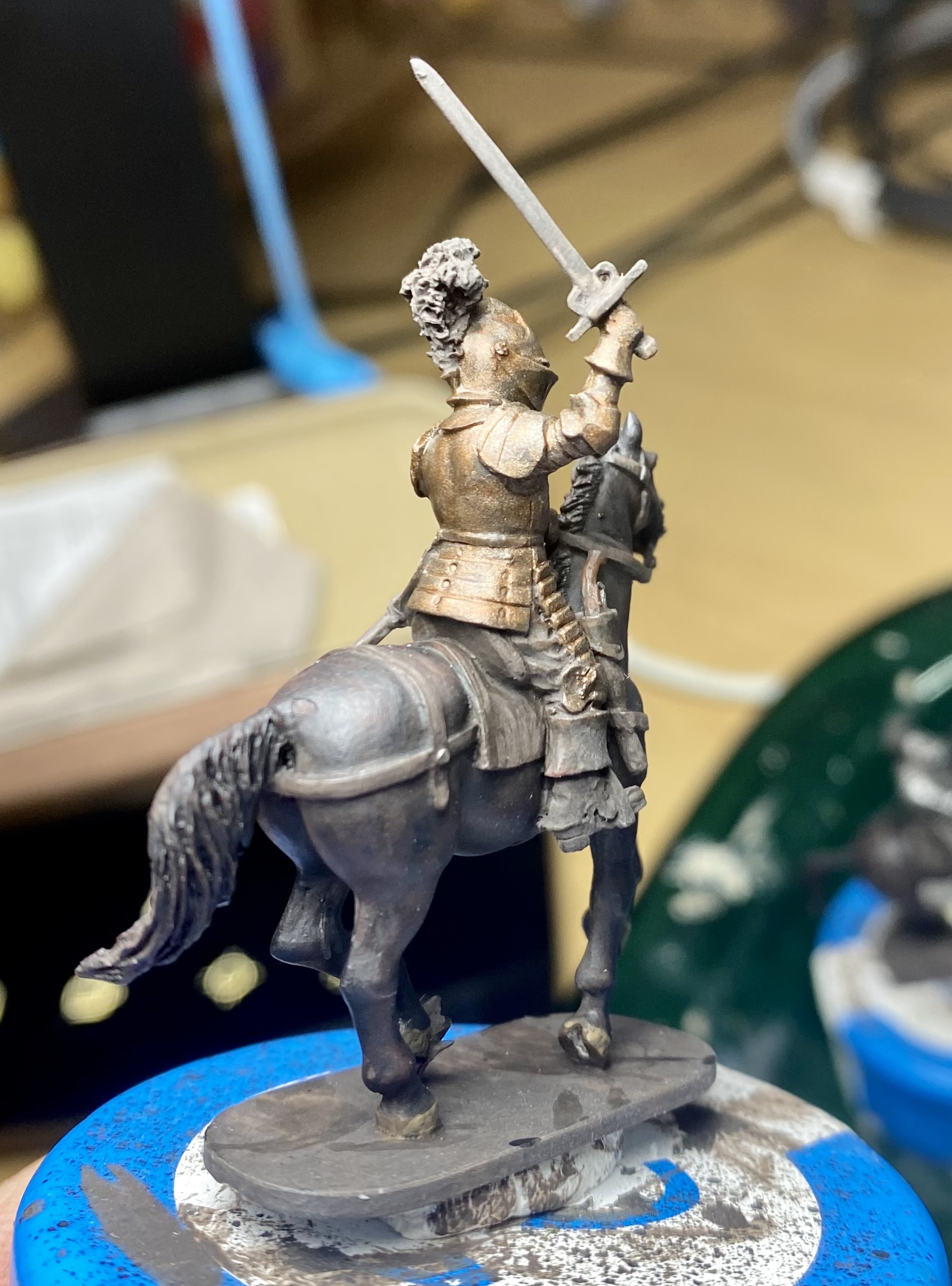
Gumetal base, dry brush with steel, and highlight with silver. Final dark wash. 

It is also possible that some individuals may have kept their armour ‘white’ (plain metal, uncoloured) if they had the available man power to constantly polish and clean it. For this I used a base coat of Leadbelcher, a dry brush of Ironhands Steel, and a wash of Nuln Oil.  For a really fancy finish (for the Cornet) I painted on some VMA Silver as a highlight.

I like the final look of the cuirassier unit in their fancy armour, and it was fun to play armour with the armour recipes. 

The cornet (flag) is from Mikhail Betskii Creation.

The trumpeter rides a Piebald horse, a popular choice in the Swedish cavalry.

As with most of my recent units I added a casualty tracker base for the unit.  This uses one of the lovely Bloody Miniatures ‘Dismounted Cuirassiers’ next to a Avanpost wounded horse.  The base is from Charlie Foxtrot. 


Next time, back to the infantry. 


Until next time,

Andy @ The Friends of General Haig (FoGH). 


Sunday, 20 June 2021

Åke Tott’s Cuirassiers

After several months focusing on my new 1620s Polish army, this blog post shows a new unit of the Pole’s adversaries in my Swedish army; Åke Tott’s cuirassiers.

28mm Cuirassiers from Avanpost Miniatures

I was inspired to create this unit after seeing the new cuirassier figures from Avanpost Miniatures (available from Mezzer’s Minis in the UK link).  I’ve written before about the superb detail on the Avanpost figures and these cuirassiers are no exception.

History

Cuirassiers were the supreme shock troops in many armies in this period. Encased in three-quarter armour, riding large horses, and armed with swords and pistols, they were fearsome opponents on the battlefield. As the Swedish king, Gustav Adolph, built up his army in the 1620s he decided he needed more of these heavy cavalry in his forces, particularly when he had to face the dreaded Polish Hussars.  By the battle of Dirschau in 1627 there were several companies of  cuirassiers in the Swedish army, although how complete their armour was is not clear.  It is not uncommon in this period for a unit of cavalry to be raised as cuirassiers, but for them to be missing parts of the armour expected for cuirassiers. This may be because the armour wasn’t available, or because the troops ‘lost’ those elements that were uncomfortable to wear over a campaign.

I’ve chosen to represent this unit with a fair proportion of figures in the classic cuirassier three-quarter armour, but one or two figures, relegated the the rear rank, are less armoured perhaps representing newer recruits.

Avanpost Miniatures


The Avanpost figures are bought individually and each comes in a small zip lock bag. Most require some assembly; typically arms and scabbards. You can see in the picture the typical contents for a bag. 

I would recommend giving the resin figures a wash in warm soapy water to get rid any residue from the production process. I used a large, child’s paint brush to make sure I could get in to all of the nooks and crannies as well as being gentle with with the thin resin pieces. You need to be gentle with the swords and scabbards in particular. 


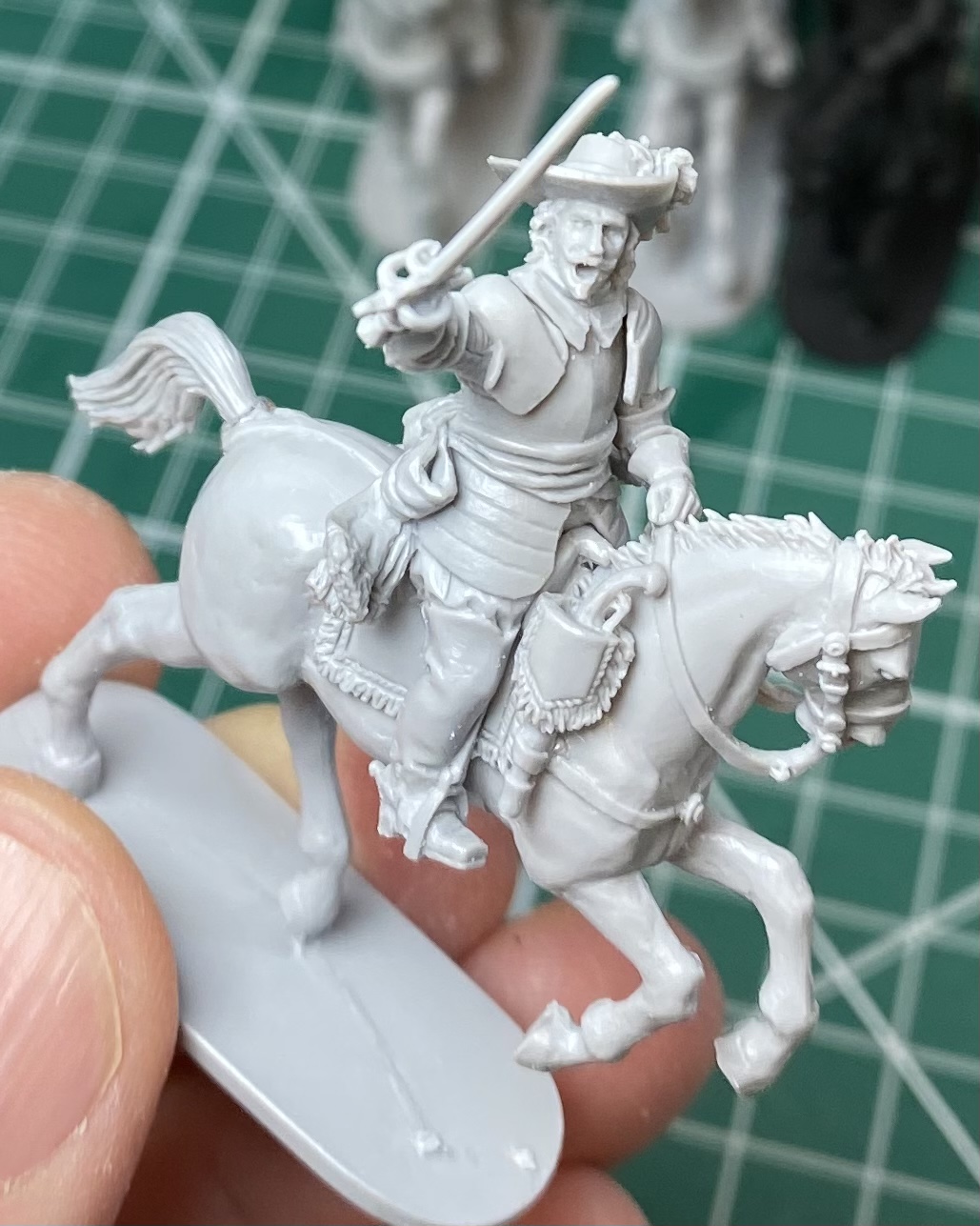
Once washed, and dried on paper towels, the figures are very easy to assemble using small amounts of super-glue.  There are not many options for varying pose without resorting to scalpel and putty, but as there is a good selection of different figures available, this isn’t a problem.  Here are a few of the figures made up.


Avanpost don’t currently offer a trumpeter figure so I added an arm from the Warlord plastic Pike and Shotte cavalry sprue that is holding a trumpet, with a smidge of green stuff to match the figure.

As the weather was wet I couldn’t spray prime the figures outside, as I normally would, and so I primed the figures by brush.  I typically use Humbrol Enamel paint for brush priming as it gives a really good base to paint on top of.  In an attempt to have an easier to use product (i.e. you don’t need to clean the brushes in white spirit!) I have been using this product from AK Interactive and it works really well - very matt and good adhesion to the figure; metal, plastic and metal. 

Åke Tott

After painting a few brightly coloured units I decided to paint this unit as a complete contrast.  Swedish (and German) troops’ armour was typically blackened in this period, to protect the metal.  I therefore kept everything else on the figure also in very dark tones.  I think this gives the unit an ominous look.  For a cavalry standard I chose to use one that is attributed to Ake Tott’s regiment.  

As his name could be interpreted as ‘death’ in German, Ake Tott played on this theme with his regiment’s standards, using a black field and a skull motif.  Who doesn’t want a flag with flames bursting from a skull’s eye sockets?!  The flag is from Flags of War.

Åke Henriksson Tott (1598–1640)

Here is the completed unit: 


Conclusion

These Avanpost figures were an absolute joy to paint; such crisp detail and beautifully sculpted figures. I’m not sure that I would mix the horse figures with other manufacturers in the same unit, but I have used the riders in the same unit with Warlord, Perry and TAG.  I enjoyed this unit so much that I have ordered another unit’s worth from Mezzer’s Minis.  

Base with the figure I converted to a trumpeter.

Love the action pose of these figure that look like they are about to pistol some poor infantry.

I included the Avanpost Mounted Commander figure in the rear rank - lovely figure!

I plan to make some more conversions on this second unit, but I think the Swedes will soon have another cuirassier unit!

Until next time!


Andy @ The Friends of General Haig (FoGH)

Sunday, 19 May 2019

The Men That Will Undo Us

'As for those fellowes (meaning the Crabats) I care not for them', saies the King: 'but charge me those blacke fellowes soundly: for they are the men that will undoe us.'  
William Watts, The Swedish Intelligencer, London 1633

The "black fellowes"
According to this quote by Watts, of all of the enemy troops, Gustav Adolf was most concerned about the Imperial Cuirassiers at Lutzen.  In their three-quarter armour, blackened to protect the metal, on large, dark coloured horses, they must have been an imposing sight.  The Imperial Cuirassiers were Wallenstein's heavy strike force.  Very expensive to raise and maintain, but also very hard hitting on the battlefield.

I need more of these armoured cavalry for my own Thirty Years War (TYW) collection, so the first thing on the painting table post Salute has been a unit of Imperial Cuirassiers.  I like a variety of figures in my units; if I can get every figure to be different, then so much the better.  I like this more 'hotch-potch' look because TYW troops were supplied from different sources at different times and would seldom have a very uniform look.  Add on to this that men, and certainly horses, will rarely have been all doing exactly the same thing, and I think some variety looks good.   One of the ways I achieve this variety is by making up my units with figures from different manufacturers.   For example, perhaps manufacturer A makes three TYW cuirassier figures and manufacturer B also makes three.  By using both manufacturers I get 6 different figures.   Obviously a bit of care needs to be taken.  Different manufactures can make 28mm figures which do not always look right when standing next to one another.  Fortunately some do.

The 'raw' figures
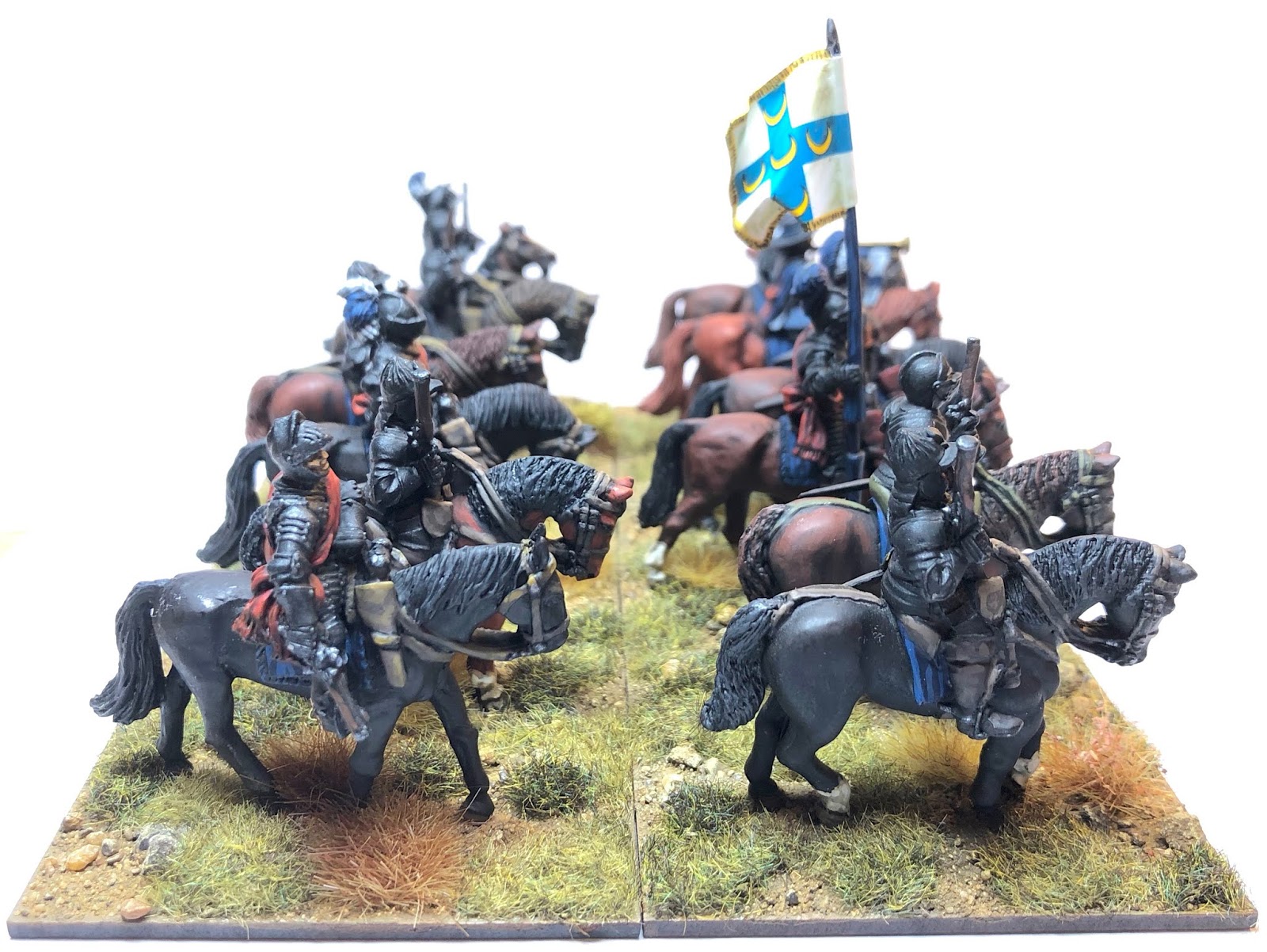
Here is my selection used for this particular unit, that I think fit nicely together.  The riders are from Warlord Games (link), Perry Miniatures (link) Avanpost Miniatures (link), Foundry (link) and Horcata (link).  The horses are from Perry Miniatures, Foundry and Front Rank (link).  Horcata don't make horses themselves but make their riders to fit on Front Rank horses.  This is interesting as Front Rank do a nice selection of stationary, or near stationary, horses.  I wanted to give this unit the look of cavalry in reserve, waiting for the order to attack, so standing horses are ideal.  Although I like some variety in the figures of a unit, I like them to look as if they are all following the same order.  So all of the rank and file here have one of their two wheel-lock pistols at the ready.

Undercoated and fixed on plastic bottle tops to make handling easier.  
Next came painting.  I am definitely not an expert at this step and so will leave it to the very many gifted painters out there to provide painting tutorials.  There were two things that I did differently for this unit.  First was that I copied some brown triads (sets of three paints that work together as shade, base and highlight) from the Loki's Great Hall Site (link).  (Loki has some great Vallejo triads on his site.)  He also has some handy YouTube videos on horse painting (link).  We are always learning and so I'm always happy to look at new techniques and ideas.

The second new painting technique was trying to get blackened armour to come out as I wanted.  This is a key feature of the Imperial cuirassiers in this period.  I have struggled to get the effect to still look like metal armour, while also not looking too mid grey.  This time I gave the figures a relatively heavy dry brush with Natural Steel from Vallejo.  I then washed this in Nuln Oil from GW.  This gave me a very black finish, with just the hint that the surface was metal.  I like the result, so this will be my new method for this type of armour.

Varnished and based.
Here is the unit varnished and based.  I under Winsor and Newton Gloss varnish (for protection), followed by Daler Rowney Matt varnish to matt things down at the end of the process. Bases from Warbases (link).   The cornet (i.e. flag carried by cavalry units) is from Flags of War (link).  It is based on Ottavio Piccolomini's coat of arms.  Piccolomini is one of the larger than life characters of the TYW who, over the course of the war, rose from the rank of Captain to the the highest rank in the Imperial forces, that of Generalissimo.  At Lutzen he was the Colonel of a regiment of Arquebusiers.  They were supposedly so well equipped that they were better armoured then some of the titled cuirassier regiments.  Due to his stellar performance at the battle he was given many rewards by the Emperor, including his regiment being changed to a cuirassier unit.  I have therefore based my unit on this later full cuirassier version of Piccolomini's regiment.

The final step is basing.  I followed my normal formula of PVA, filler, sharp sand, and Humbrol Matt 29 Dark Earth, with a light dry brush of Cream/Beige.  Tufts and static grass added to taste.

The final 12 figure unit.
Here are some further shots from different angles.


Riding off!
As Piccolomini's Cuirassiers ride off in to the sunset, I am about to start the next unit on the painting table; more cuirassiers, this time with swords rather than pistols.

Until next time!

Andy mk1 @ FOGH.