Sunday, 30 January 2022

More Haiduks

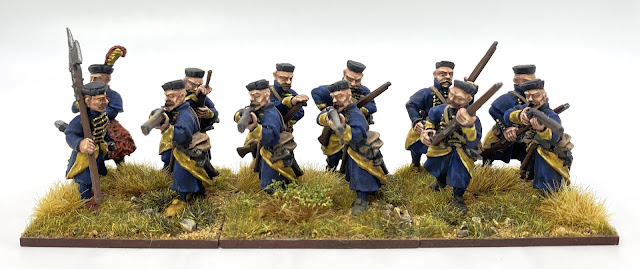
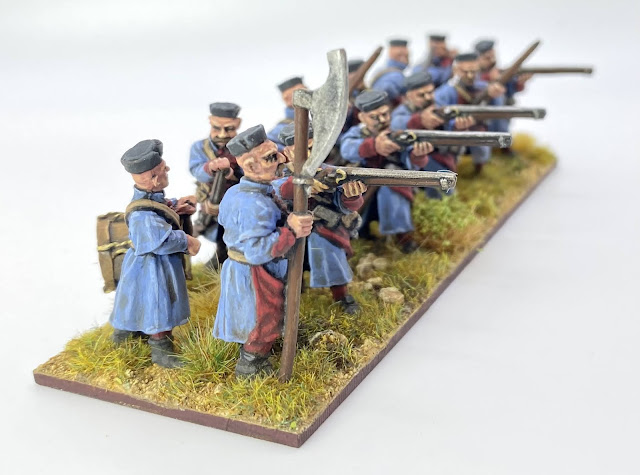
This blog post looks at the latest unit for my Polish Lithuanian Commonwealth army; another unit of Polish Haiduks. 

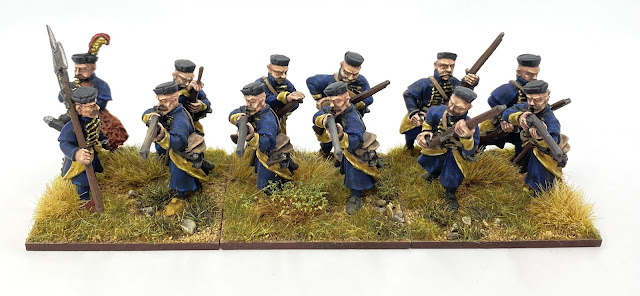
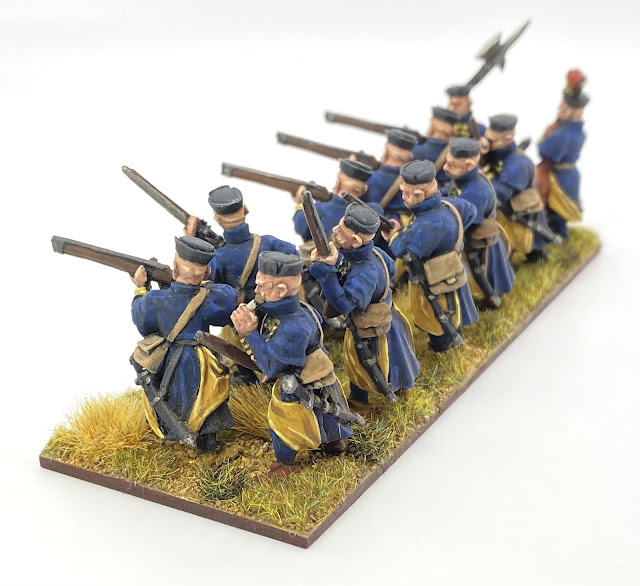
Polish Haiduks from Wargames Foundry and TAG in 28mm

In this earlier post (https://theviaregia.blogspot.com/2021/11/polish-haiduks.html) I described the background to these native Polish infantry. This unit is more of the same, with the figures also being from Wargames Foundry and The Assault Group (TAG) in 28mm.  

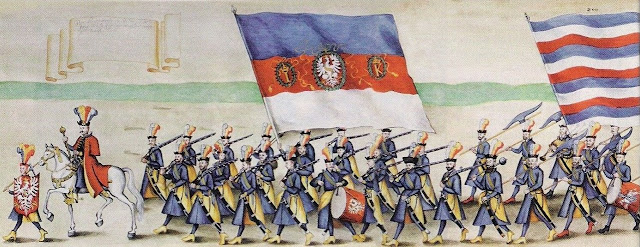
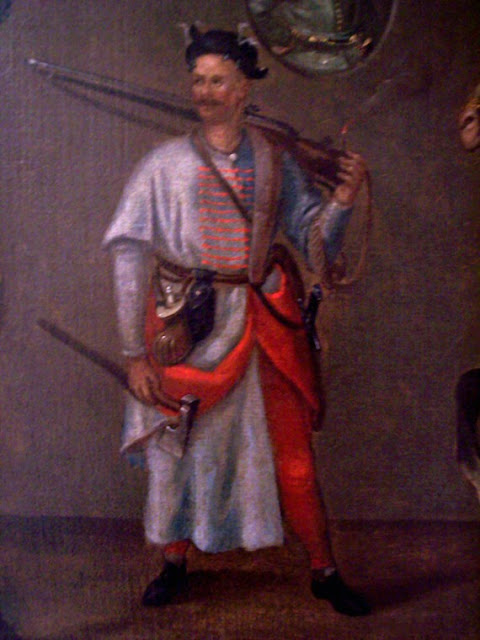
Extract from the contemporary ‘Stockholm Roll’ showing Haiduks

I chose a different paint scheme this time, with this unit being based on a unit of Haiduks in the Stockholm Scroll. This amazing 15m long work of art depicts the ceremonial entry of the wedding procession of King Sigismund III and Archduchess Constance of Austria into Kraków on 4th December 1605. The picture includes many military units, including Haiduks. This needs to be used with caution of course as this is a ceremonial procession and not a battlefield. It is nevertheless very useful. There is a great Wikimedia page with details of many parts of the scroll here: https://commons.m.wikimedia.org/wiki/Category:Stockholm_Roll

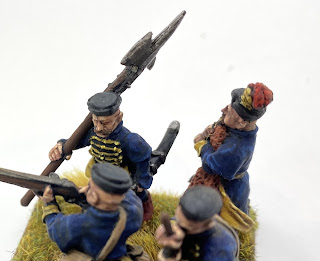
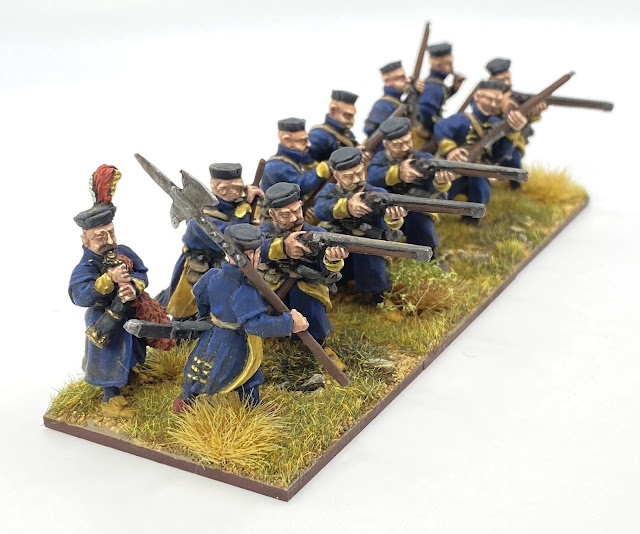
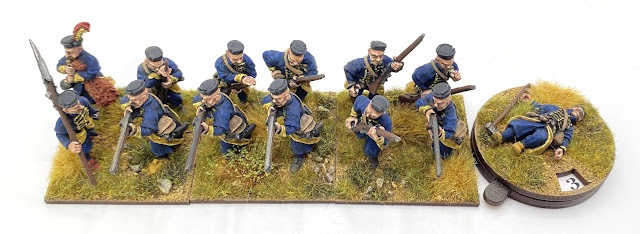
This unit of Haiduks on the scroll have a nice dark blue uniform with a yellow lining on the outer coat. The figures in the scroll don’t seem to have braiding on their coats but as my model soldiers do, I have given them braiding in the same contrasting yellow. 

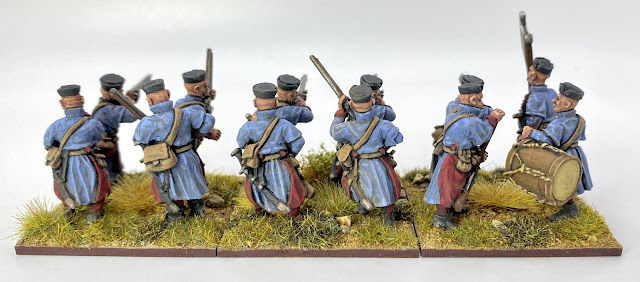
A ‘tenth man’ and musician.

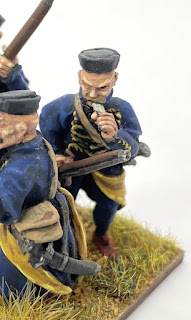
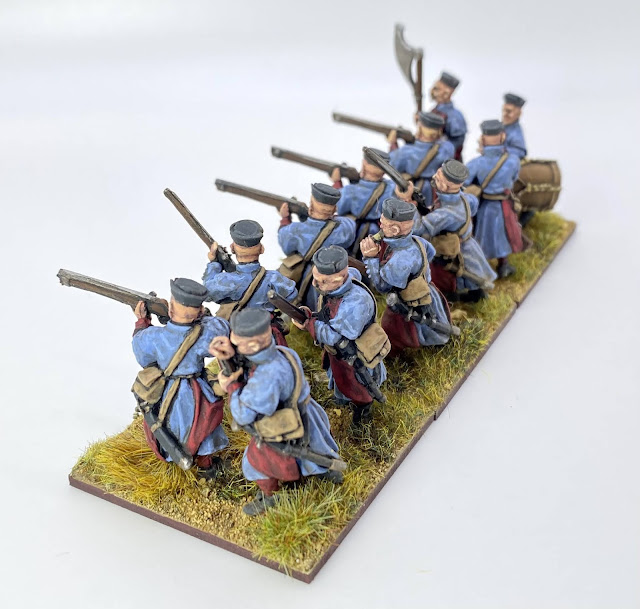
Biting open a cartridge.


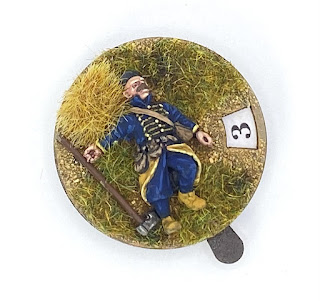
Casualty Marker from Warbases

I painted the figures using the same approach as described in the previous post above. I think they’ve come out alright. I’ve added a casualty marker for the unit as well, using one of the handy counter bases from Warbases. 


The scroll shows further Haiduk uniforms and so I will be trying these in the future. Next up, my Haiduks need some commanders.

Until next time

Andy @ The Friends of General Haig. 

Sunday, 16 January 2022

Even More Husaria!

This blog post looks at my latest unit of miniature Husaria.

Polish Hussars from Warlord Games, 28mm

Long term readers of the blog may remember that when I started the Hussars for my Polish-Lithuanian Commonwealth army I looked at three different manufacturers (see https://theviaregia.blogspot.com/2020/05/husaria.html). I decided at this point that the Warlord figures looked a bit later than 1620s period that I was aiming for, and were perhaps more suitable for the 1670s onwards. The units I’ve used so far have been from Foundry and TAG. Well, the thought of that box of Warlord Hussars sitting in my lead mountain had been a niggle in the back of my mind. Then the box was inexplicably joined by another! (Thanks, Phil!) This was too much to bear, and so I decided that I had to paint up a unit with the Warlord figures.

So here is a quick run down of the Warlord Games, Polish Winged Hussars box set. You get eight metal riders and eight metal horse figures in a box. As I form my cavalry in units of 12 figures I needed two boxes to make a unit, and of course three boxes will allow me to make two units! 

As I noted before, the Warlord figures are in very dynamic poses. There are four different horses, all in different states of galloping forward. One of the horse poses looks a little odd to me, but once ranked up with the others it is fine. The horses all have nice ‘fancy’ horse furniture, befitting these noble units, and have pistol holsters and the long koncerz type sword  on the left side of the saddle. 

There are six poses of hussars with lance, two at the charge, and the rest in various more ‘lance upright’ poses. There is also an officer figure, with two options for his right hand; either a sabre or a bulawa (a ceremonial mace). Finally there is a trumpeter. One of the lancer models can be used a standard bearer. 

The figures come with a nice selection of separate wings, also in metal. There are three different designs, all of which are probably of the later types of design in which they curve forward. The hussar figures have been sculpted to allow one or two wings to be added either to the riders back, or to rear of the saddle. Wings attached to the rider’s back seem to be later and final design for carrying wings. I chose to use the wings mounted to the rear of the saddles, that are moulded as part of the riders. I avoided using the most curved wings, and also used some shorter, straighter wings that I had in my stash for a bit of variety. By using the less curved wings, and by saddle mounting them, I was in my mind at least, giving the hussars an earlier look. The hussars armour still gives them a look that suggests to me, later than the 1620s. 

Warlord provided nice brass 80mm long spears for the lances. Hussar lances included a ball shaped hand guard. To represent this Warlord provide some small metal ball shaped hand grips in the set. These come with holes drilled through them which allow them to be mounted on the brass spears. This is a lovely touch and I have used this approach for all of my previous units of hussars. 

With the variety of horses and riders, all in dynamic poses, fitting everything together took a bit of time. This allowed for some experimentation and a small bit of filing and filling to get riders and mounts to fit neatly, with wings added to the saddles. As I wasn’t using the back mounting points for the wings these needed to be filled with some green stuff. I also made sure that the riders who would be carrying lances had their right hands drilled out, although I would fit the lances later after painting. 

Despite having the riders and mounts matched, I painted them separately. This requires a numbering system on the paint ‘handles’ to help match the correct riders to the correct mounts after painting. The figures were really nice to paint with lots of crisp detail. The horse tack is suitably fancy, and the hussars’ armour is also covered in a lot of detail. My humble skills could only go so far with this, but there is plenty of detail there to satisfy a really keen painter.

My attempts at tiger and leopard pelts.

There are loads of details to paint on the horses and riders.

An extra exotic snow-leopard.

I glued the riders to the horses after they were painted. Before adding the lances I painted the lances and added the lance pennants. These are from Flags of War and the cavalry standard is from a set of free downloads on Jose Manuel Chasco’s site (see here https://www.anotherminiaturespainter.com/wargames/28mm-polish-renaissance-cossack-flags/). Warlord provide pennants and a flag as part of the information leaflet in the box, but I had already used the design they provide on a previous unit and I wanted these to look different.  With the lances on the figures it was time for my regular basing. (See https://theviaregia.blogspot.com/2021/04/husaria-from-ground-up.html.)


I am really pleased with the finished unit. Despite the button-counter part of me knowing these look a little late for my 1620s army, they may sneak on to the tabletop to join their earlier comrades; they’re just too nice not to use! 

The finished unit placed into its Really Useful Box for storage.

Until next time!

Andy @ The Friends of General Haig (FOGH). 


Tuesday, 28 December 2021

“Bring on the Empty Horses!”

This blog post looks at providing riderless horses for the dismounted dragoons that I covered in my previous post. 
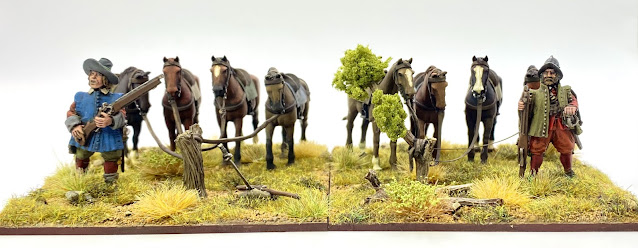
Horses for my dismounted dragoons, with horse holders from Bloody miniatures - 28mm

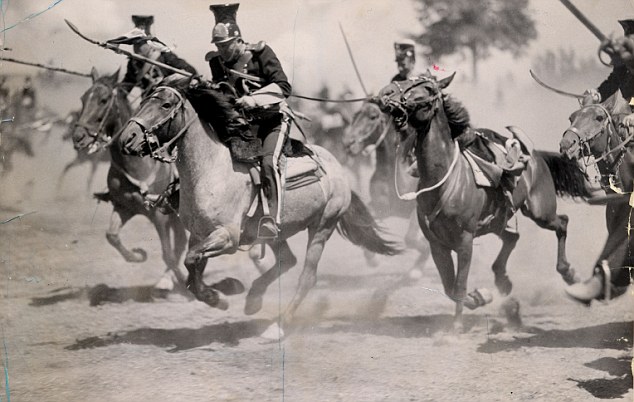
[Note. The title of this blog post is taken from David Niven’s autobiography. During the filming of the 1936 version of The Charge of the Light Brigade, starring Errol Flynn and David Niven, the director shouted this memorable phrase when he wanted the riderless horses brought in to the scene of the charge itself.  Ever since learning about this, our club has always referred to the riderless horses, used to represent dismounted dragoons and cavalry, in this way. ]

Errol Flynn in the 1936 version of Charge of the Light Brigade

An “empty horse” from the film.

My previous post covered James Butler’s dragoons, a unit in my Polish Lithuanian Commonwealth army for the 1620s (see https://theviaregia.blogspot.com/2021/12/what-butler-recruited.html). These were foot figures and I needed something to help represent them as dragoons. While dragoons typically fought on foot, I think it looks better to have something on the table top to show that they have mounts as well. 

The most fool proof approach would be to have a mounted version of the unit, a dismounted version, and set of riderless horses.  I have done this for previous units of dragoons but I have found that swapping the mounted unit off and back on to the table, as the dragoons dismount and remount, is a complete faff.   Typically, after doing this for the first time in a game, the mounted unit gets left off the table and some other convention is used to indicate if the unit is mounted or dismounted. Adding to this, I struggle to think of a game in which my dragoons have remounted during the action.

On this basis, for Butler’s dragoons, I have decided to just provide riderless horses to indicate the unit of dragoons. These riderless horses are from Avanpost (https://www.mezzersminis.co.uk/product-page/21-081-dismounted-dragoon-horse-holder).  They are sold in packs of two horses with a dismounted horse holder.  

Contents of the Avanpost 28mm resin Dismounted Dragoon pack.

I have chosen not to use the Avanpost horse holder minis, but instead used figures from the Bloody Miniatures range; the same used for the rest of the dismounted dragoon unit. For my riderless horses I have decided to use 8 horses and 2 horse holders. This is enough to give the impression of a set of riderless horses, held ready for the dragoons to remount at a moment’s notice.

Swappable horse holders.

I gave myself two additional challenges.  First, I wanted to be able to swap out the horse holder minis, and so be able to use the riderless horses in other situations. Secondly, I wanted to model how the horses were tethered. 
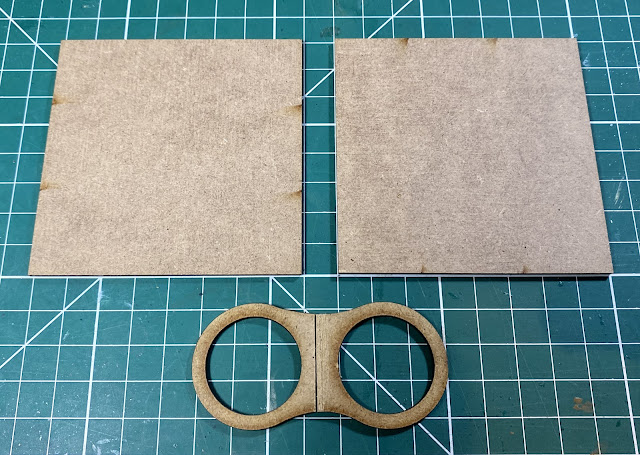
The top of a Warbases 2 x 2p base ‘tray’, cut in half, and the two 8cm square bases.

I used two 8cm square bases (2mm MDF from Warbases) for the horses, with 4 on each.  On each base I added part of a top piece from a Warbases basing tray, the same dimensions as my dismounted dragoon figures’ bases (UK 2 pence piece / 2p). Using one of the Warbases’ 2p  sized MDF bases with magnet holes I marked where a matching magnet hold would need to be in the 8cm square base and drilled a 5mm hole there. I then added a magnet (checking that the polarity would match the figures’ bases, of course!) to the square base. This provides a single figure base tray / sabot for a suitable horse holder figure that is also magnetised to stop the figure accidentally falling off the base.

The top of a base tray glued to the 8cm square base.

A Warbases 2p sized base, with a 5mm magnet hole, used as a template to mark where the magnet hole needs to go in the 8cm square base.

I realise that this is an entirely unnecessary step as I could have just permanently stuck a generic horse holder figure to each base, but is was relatively straightforward to do, and it satisfied my desire to get the most use out of painted figures. 

A metal tree stump with 4 tethers attached, from the Warlord Dragoon set, used to tether four of the Avanpost horses. Note the single base tray, with magnet, ready for the horse holder.

Scratch built tree stump and tethers made with twig, plastic card and green stuff bits.

For the tethers I had two solutions. When 17th century dragoons dismounted the horses’ reins would be passed to the men designated to stay with the horses, and so the horses in all likelihood would be tethered using their reins. The Avanpost figures are modelled with their reins loose, in front of them, but these were too short for my purposes and, being very thin resin, incredibly delicate. I therefore removed them and replaced them in two ways.

The first was to use a white metal piece that comes with the Warlord Dragoon set.  This has four sets of reins, all tied to a tree stump.  I only had one of these in my spare parts box, and so for the other four horses I made the stump from a garden twig, and the reins from thin pieces of plastic packaging.   Once the stumps, with reins attached, were glued to the bases the other ends of the reins were glued to each horse’s bridle. 


Extract illustrations from Wagner’s European Weapons & Warfare 1618-1648, published by Winged Hussar Publishing. 

[Historical note. Looking at Wagner’s European Weapons & Warfare 1618-1648, it’s possible that the loose horses’ reins were looped through the next horses reins in a daisy chain effect with the last set being held by the dismounted horse holder.  Wagner notes that this made separating the horses a laborious process as each horse could only be separated one at a time. I decided this would be tricky to model and so I have used an approach with each horse’s reins tied to a handily placed tree stump.]

The completed bases with horse holders/guards and some scenic scatter added to the bases.


The final bases are now ready to follow Bulter’s dragoons on the battlefield. I shall use them facing forward to represent the dragoons mounted, and facing to the rear to represent the dragoons dismounted. I am sure the bases will also come in handy for other occasions when the cry of “Bring on the empty horses!” is heard across the miniature battlefield. 

Until next time,

Andy @ The Friends of General Haig.


Thursday, 16 December 2021

What The Butler Recruited

This blog entry looks at a new unit for my 1620s Polish Lithuanian Commonwealth army, a unit of dragoons.

Butler’s Dragoons, dismounted. 28mm from Bloody Miniatures.

Background

European armies in the early 17th century were experimenting with mounting units of infantry to improve their mobility and therefore their ability to support their army’s cavalry. The experiments were successful, where the mounted infantry were equipped with muskets, and the dragoon as a troop type was born. They were able to dismount and provide fire support to the real cavalry and, off the battlefield, they were well suited to the typical activities of the ‘small war’; raiding, scouting and garrisoning outposts.

Assault on a Convoy, by Sebastiaen Vrancx with Jan Breughel the Elder.  A typical action of the ‘small war’.

Polish armies were no exception and in the 1620s they were forming units of dragoons, typically recruited from foreign troops (see my previous entry on the Foreign Infantry here: https://theviaregia.blogspot.com/2021/03/polish-lithuanian-foreign-infantry.html ), and sometimes converted from existing infantry units into dragoons. Dragoons use on and off the battlefield required smaller, flexible sizes of units, and so just a few companies of infantry may be converted to dragoons rather than larger formations.  

James Butler

The unit of dragoons I decided to collect was that belonging to James Butler, as it is likely that they were at Dirschau/Tczew in 1627. James Butler was an Irish noble who had been fighting in Polish service since at least 1617. He seems a fascinating character. (Short bio here: https://www.st-andrews.ac.uk/history/ssne/item.php?id=6450 .)  He was an experienced, and successful, officer who was well connected in England and Ireland, as well as in the Commonwealth, and it appears he recruited at least some of his men from England and Ireland.  His dragoons were formed from some of his existing ‘foreign’ infantry companies.

(While looking in to James Butler I discovered there were several James Butlers from Ireland serving in Polish and Imperial armies in this period.  This makes things a bit confusing, but the Butlers were obviously a family whose sons were often seeking employment abroad.)

A company being ambushed in the Thirty Year War by Peeter Snayers.  An opportunity for plunder!

Dragoons seem to have had a reputation, at least among the more puritanical in England, as being too often tempted in to ‘plundering and ungodliness’. I suspect this reputation may be a result of dragoons often being quartered away from the main army with its commanders, and also due to their function often being the disruption of the enemies supplies. 

Based on this I wanted my unit of Butler’s dragoons to look like they have been living off the land and what ever they can ‘acquire’.  Also to look like they are following their own whims of personal comfort, rather than being uniformed. As they are treated as skirmishers in the Pike & Shotte rules, a good variety of poses would also be required to represent the dragoons defending some outpost or attacking the enemy rear areas.

All of these requirements fitted neatly with the latest release of figures from Bloody Miniatures.  This second release includes a couple of sets with muskets (Game Keepers and Sentinels) and also a set of desperate and dangerous looking Mossers (Moss Troopers). With the addition of a few figures from the original release, I had my 12 figures, including command, as well as a couple of horse holders (more of them in the future).

The Halt of the Cavalry by Peeter Snayers.  I like the dishevelled and ragtag appearance of this unit that Snayers has chosen to represent.

I also decided to do some head swaps to add a Polish feel to the unit. Although these men would have been recruited from foreigners I rationalised that a few items of Polish headgear could have made their way in to use in a unit that sometimes had to operate, and fend for themselves, away from the main army.

Three figures with head swaps to give a flavour of troops fighting in Poland.

As desperado dragoons were certainly not going to be uniformed and so I was able to fully explore my paint racks in deciding on colours in which to clothe each figure. They’ve also been given a fairly grubby appearance to suggest they’ve been on campaign for a while.

Cornet, Officer and Drummer.

The command figures for the unit include a Cornet (flag bearer) carrying a dragoon guidon. Sadly Butler’s foot and dragoons don’t have any known flag designs. I’ve used an example that is possibly from an unknown Polish dragoon unit (see  https://www.helion.co.uk/military-history-books/despite-destruction-misery-and-privations-the-polish-army-in-prussia-during-the-war-against-sweden-1626-1629.php?sid=d20622fac8e2f6ae07608fbfa93e14e3 ).  I’ve also included a drummer, with a handily slung drum, that will help him get about when mounted. 


They are based individually so that they can act as skirmishers in Pike & Shotte and this will also give me the opportunity to use them in skirmish games like En Garde or Pikeman’s Lament (both by Osprey Games).  I used to use 2 pence pieces for individual bases, but I don’t seem to get much loose change anymore, and so I’m switching to 2 pence size bases in MDF, produced by Warbases, which have a hole in them for a magnet that will help with storage.  I’ve also bought some movement trays from Warbases to make it easier to move the Dragoons around the battlefield. These also include magnet holes which should help keep the figures on the trays.

2 pence piece bases and base trays from Warbases, all with 5mm magnets added.

Figures on this movement trays from Warbases.

At this point I suspect some people might be saying “This is just a unit of infantry, where are the horses?”. Good point.  You’ll have to wait to next time for my cunning plan to be revealed!


Until next time,

Andy @ The Friends of General Haig


Tuesday, 30 November 2021

Polish Haiduks

In this blog post I cover a new addition to my Polish-Lithuanian Commonwealth army, a unit of Polish Haiduks.

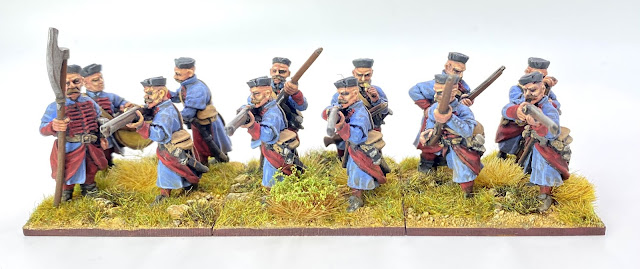
Polish Haiduks - 28mm from Wargames Foundry & TAG

My painting progress over the summer and autumn has been almost nonexistent and so I am really pleased to be back in the saddle, so to speak!

Haiduk (or Hajduk) was a term used in this period for native Polish and Hungarian infantry. They were armed with muskets and provided fire support to the cavalry arm in open battles, as well as providing the ability to hold fortifications, or indeed assault enemy fortifications. Along with their firearms they were equipped with sabres and hand axes, which they used when involved in hand to hand melee.  They were typically uniformed, and their coats (called a zupan) were usually lined in contrasting colours. The Haiduks therefore provide a distinctive and iconic part of any Polish force, and I have been looking forward to getting some of these on the painting table since I started my Polish army.

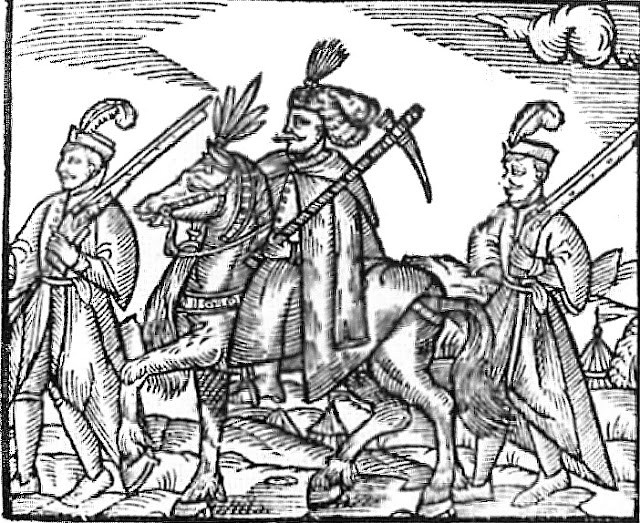
Contemporary picture showing a Polish noble escorted by his Haiduk bodyguard.

The Polish infantry were recruited, like the cavalry, through the issuing of a commission to a Rotmistrz.  The Rotmistrz had to recruit the required number of  men as instructed in their commission, and they typically did this in their own home region, looking for volunteers amongst the townsfolk and peasants. The infantry were formed in to banners (companies) with a set of officers, and each tenth man was armed with a long axe or halberd. These tenth men acted as NCOs, directing the rank and file, and were also meant to act as a defence against cavalry with their pole-arms.  

My 28mm miniature Haiduks have been recruited from Wargames Foundry and The Assault Group (TAG).  Like their Hussars, the Foundry Haiduks are a very old range, and so a little on the short side being closer to 25mm than 28mm, but they fit in ok with TAG to my eye. The details on the Foundry figures hold up well; all part of the Perry sculpting genius! 

As well as a tenth-man with his halberd, I have also added a drummer to the unit. Various types of musicians are shown in Haiduk units including fifers, pipers and drummers. 

Contemporary colour picture of a Polish Haiduk

This first unit is painted up in one of the most common colour combinations shown for Haiduks in this period; a lightish blue coat with deep red lining. I want to acknowledge the fabulous painting tutorial by Sonic Sledgehammer that I used as inspiration for this unit, after I saw Troy painting a TYW Bavarian musketeer in just the shade of blue I wanted to use (see the tutorial here: https://youtu.be/ZqpHAV_A1U0). 

I plan to add a few more units like this to the army, and also some separate command bases. The Stockholm Scroll (https://commons.wikimedia.org/wiki/Category:Stockholm_Roll) shows a number of Haiduk units, with a variety of uniform colours and I hope to represent these with the future units. 

Until next time!

Andy @ The Friends of General Haig