Friday, 17 September 2021

Auldearn 1645 - The Battlefield


Mac Colla’s lifeguard charging out from a village building.

… Let it never be thought that they have triumphed over our currage, nor the loyaltie we ow to our soveraigne lord, and let ws hope the best. God is stronge enough!” Mac Colla urging his men for one last desperate charge to hold off the Covenanters.

This blog post continues to look at Mac Colla and Montrose’s victory at the battle of Auldearn in 1645 as part of the War of the Three Kingdoms (the ECW if you will).  The Friends of General Haig are running a game recreating this battle at the Warlord Games Open Day on 25th September (https://store.warlordgames.com/products/warlord-open-day-ticket-2021).  

You can see my first blog entry on Auldearn here: https://theviaregia.blogspot.com/2021/09/auldearn-1645-boath-doocot.html

Hurry’s Covenanters surge on to the battlefield, taking the sleeping Royalists by surprise!

This time I’m looking at the terrain needed to populate the battlefield.  The key features of the battlefield are the village of Auldearn, two pieces of high ground, and some boggy ground.  These will give each of the two armies different challenges to consider in their battle plans. The battle is also a surprise, dawn attack by the Covenanters, rather than a more classic encounter battle where both armies have the opportunity to deploy before the fighting starts. (See the brief background to the battle that I wrote on the Warlord site here: https://www.warlordgames.com/warlord-games-open-day-auldearn-1645/)

The battle starts in the early morning with the Covenanters hurrying to deploy from the march columns in which they approached, and then rushing to scatter the Royalist forces around Auldearn before the Royalists can be gathered together from their sleeping quarters, and formed up into units. 

Between the road where the Covenanters march on to the West end of the battlefield, and the village, is the long, low Garlic Hill.  The North East and East sides of this hill descend in to some boggy, marshy ground, in front of the village itself.  The buildings and associated enclosures on the west side of the village provide some cover to troops defending them. At the North West end of the village is the smaller hill, called Castle Mound (topped with the Boath Doocot). These are the key features of the battlefield. 

This map shows how the miniature battlefield is laid out, and the initial troops deployed.  This is how the key features of the terrain will effect the game: 

  • Garlic hill is gently slopped giving no great advantage to troops uphill.
  • The marshy ground at the bottom of the North-East, and East sides of Garlic hill should be inconvenient to troops passing through it, slowing them down to a degree.
  • Castle Mound is more steeply slopped and troops uphill should receive some advantage in melee over troops coming up the hill.
  • Finally, the yards and buildings of Auldearn should confer some benefit to defenders.

The Gordon Horse ready to sally forth from the Chapel yard.

These effects are translated for the rules, Pike & Shotte, as follows:

Marshy and other Broken Ground

  • Maximum of one move per turn.
  • Pike and Horse disordered on a roll of 5 or 6.
  • All others disordered on a roll of 6.

Village Buildings

  • -1 to hit Defenders (Not Clear Target)
  • +2 Morale (Save) for Defenders
  • +3 Combat Resolution for Defenders
  • Other rules as per main rule book

Castle Hill (Steep Slopes)

  • +1 Combat Resolution for Defenders
  • Attackers get no Charge bonus

For this game the fighting is taking place down the length of the wargames table so that we can recreate Hurry’s Covenanters arriving in a column and trying to rush the enemy defences, while Mac Colla’s advanced guard try to hold off the Covenanters until the Royalist army forms up. A table in the region of 8’ x 5’ works well for 28mm armies using the Pike & Shotte rules. 

For the game at Warlord’s Open Day we will be using terrain boards specifically modelled to allow refighting Auldearn with the main hills, Garlic Hill and Castle Mound, included.  It is fairly straightforward to create something similar by adding to a flat table a fairly large, long hill to represent Garlic hill, and a smaller hill, perhaps with steeper slopes to represent Castle Mound.   

For the village of Auldearn a collection of small rural type buildings, suitable for the 17th century are needed. (It’s not essential to include Boath Doocot, covered in the previous blog post, as it can be left out by assuming it hadn’t been built at the time of the battle, which is quite possible!) I have used a selection of buildings, including a small chapel to represent the original village church.  These should fit with the illustrations and details provided in the Osprey Campaign book on Auldearn.  

The buildings I have used are from a variety of sources:


Supplied by Warlord Games, produced by Tabletop Workshop, a Cottage and Medieval Chapel. These are incredibly sturdy, easy to build and really nicely detailed. 

From Perry Miniatures, a Medieval Cottage.  A lovely detailed model which comes with some handy wattle fencing and an outbuilding. 


A smithy and a grain store, both really nice resin buildings.  (I received these as gifts and I’m not sure who made them!) These both have great interior details and removable roofs. 
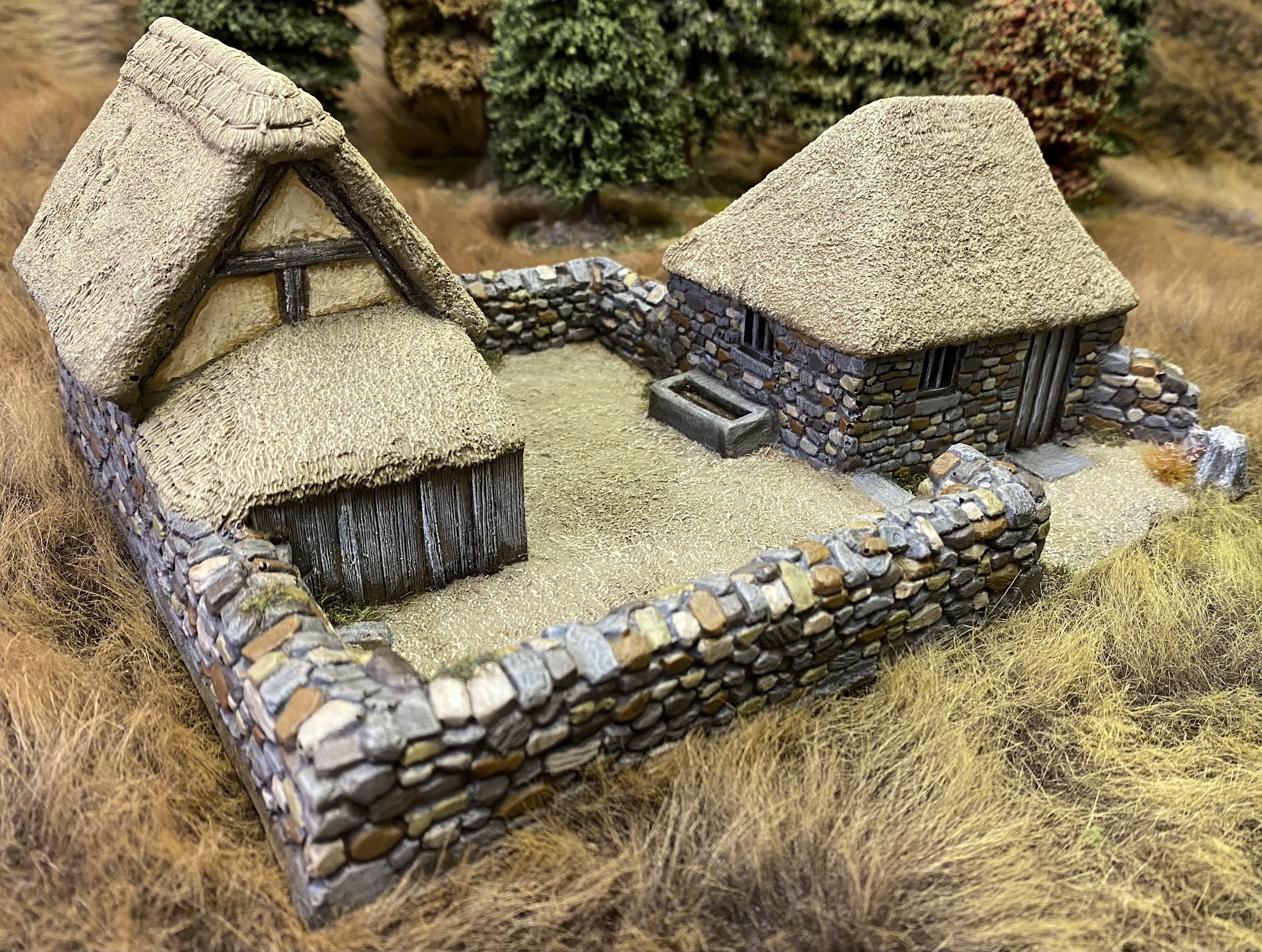


Produced by Hudson and Allen, from their Medieval village set. These are made from some sort of extruded foam. They are as detailed as resin, but much lighter and more robust.  No interiors, but lovely details on the outside.

As the fighting will probably spill into the village, just as it did in the real battle, it is necessary to allow for this in modelling the village buildings. I have built a number of yards, or small enclosures, that allows the built up area to be easily split in to defined sections.  It is then possible to nominate how many units can defend each section, and therefore also how many can attack a section.  Model buildings are placed in the enclosures, and can be moved to facilitate placing troops as required.  Having a village broken down in to easy sections likes this makes fighting around buildings much easier in Pike & Shotte.

To make the enclosures I used a mix of fencing and walls, added to Warbases’ Terrain Bases in a variety of sizes.


Supplied by Warlord Games, made in plastic by Italeri, Stone Walls set. This is a really useful set with gates and gate posts included. 

Produced by Ferris games, these are probably the most detailed and realistic dry stone walls I have seen. Gate posts here made with pieces of balsa. 


From the Perry cottage set, the included plastic wattle fencing. 

The last part of the key terrain features is the marshy, boggy ground just outside of the village.  Some scatter terrain pieces, representing marshy and rough going is used to represent this area.  These are easy to place on the table where needed and can be moved to allow troops to be placed if necessary.  

Some of the Irish Brigade charging through the bog.

The scatter pieces are made from scraps of card.  These have had sand with PVA added, and then painted in the same way as when I base my figures. Some areas have been left clear of sand and painted to represent pools of water.  The pools were gloss varnished for a simple ‘wet’ effect.  Finally, when the varnish was completely dry, tufts, clump foliage and scenic grass were added.

The wargames table would look a bit bare with just these key features modelled and so, as can be seen from map above, the table also had woods and farmsteads to add some interest and colour.  Although not absolutely necessary for the game, the Royalist camp is also represented around the village with suitable tents, wagons, pack animals, baggage, and camp followers.  A final touch is to add some of the locals with their flocks and herds.


The civilians and scatter terrain are from a myriad of places but I will detail a few of my favourites.  Warlord do 17th century civilians, club men, as well as wagons, livestock and vignettes, like the surgeon.  Warbases have carts and other bits of baggage. Ainsty Castings have useful collections of barrels and sacks.  Renedra do the plastic soldiers’ tents.

I hope this description of how the battlefield has been represented will provide some ideas to others. Next time I will cover the orders of battle for the two armies.

Alba gu bràth!

Andy @ Friends of General Haig.

Sunday, 12 September 2021

Auldearn 1645 & Boath Doocot


“Health and joy to the valiant Alasdair who won the battle of Auldearn with his army,

With his fine soldiers, who at the outset of their march loved to sing his marching song.”

From ‘A Song To Alasdair Mac Cholla, after the battle of Auldearn’ by Iain Lom, translated from Gaelic by Annie M. Mackenzie

The Battle of Auldearn, 1645, starting with the Covenanter dawn attack

In this blog post I am taking a short break from the Polish-Swedish war and switching to Scotland in the War of the Three Kingdoms (or ECW in old money!).  The lovely folks at Warlord have asked The Friends of General Haig to come to the Warlord Games Open Day on 25th September (https://store.warlordgames.com/products/warlord-open-day-ticket-2021) to put on a game of Pike & Shotte.

Warlord’s Open Day has become a bit of a tradition for us and we’re always happy to make the pilgrimage to the Nottingham ‘Lead Belt’, the heart of wargaming in the UK!


Grab your tickets, while available, here - https://store.warlordgames.com/products/warlord-open-day-ticket-2021

Intro to the Open Day 2021 on YouTube here https://youtu.be/n1-tHvMQ1z4

We’ve decided to put on the Battle of Auldearn 1645, in a replay of the game we did in 2018. (You can read about it, including my brief historical introduction to the battle, on the Warlord site here https://www.warlordgames.com/warlord-games-open-day-auldearn-1645/.)  This is a nice compact game, with lots of nice scenery, and two tartan-tastic armies.  In the next couple of weeks I’ll share on the blog some of the things built or painted for Auldearn, as well as the orders of battle etc.

To start things off, here is how I re-created one of the iconic parts of the Auldearn battlefield; Boath Doocot.  This still stands today on Castle Hill, itself the remains of a 12th century motte and bailey castle. This hill was probably Montrose’s command position during the battle and also where the Royal Standard was flown. Archeology has also suggested that the Royalists may have had some artillery firing from this position.  

Boath Doocot - Auldearn

The Doocot, a Scottish version of Dovecot, was a traditional building to breed doves for their eggs, meat and droppings!  The current building held over 500 nest boxes. Recent archeology suggests that the current building was built later in the 17th century, after the battle, but it may have been built on a previous structure in the same position. Taking this information as the inspiration for the terrain piece I set about to model a similar round building.


I suppose that I could have just scratch built a round tower but I decided to use a plastic round tower as a base. This used to be available from Warlord, but is now sold by North Star https://www.northstarfigures.com/prod.php?prod=14747 .

I used just two levels to get the height I wanted for the Doocot.  The kit goes together fairly easily and is very solid.  It is definitely worth dry fitting pieces as a test when building as, although logical, there were no instructions in my copy.  

This most tricky bit was making the conical roof.  Now, I’d love to say that I fell back on my school geometry to work out the size of the circle required to cut to make the size of conical roof, but I have to admit that I ended up using trial and error and some card from packaging to get the right result. 16cm with a quarter of the circle cut out seemed to work.  The conical roof was bent in to shape and then held together with sellotape. The cone was then glued on a floor section, and the floor section attached to the tower. 

One distinct feature of the tower was a line of running around the building, about half way up the walls. A bit of research suggested this was a feature designed to discourage rodents etc. from scaling the walls to get inside.  Apparently this course of projecting brick work makes it difficult for rats etc. to scale the sheer walls, and then gain entry, to raid the nests inside. This line was replicated on the model with a thin strip of mounting board, glued around the tower.


The roof was tiled with strips of tiling available from Warbases in handy A4 sheets. This was a bit fiddly and I’m sure it would be possible to get a better finish if more care / time was taken.  The result here is ok, if you don’t look too closely!  The roof was finished off with a small cap of card. 


Next a doorway and windows were added using small pieces of card, balsa and a laser cut door, again from warbases. These were modelled on those of the current building there being nothing better to go on regarding the possible original building.

The building was also rendered over the plastic stonework using a mix of PVA and filler, coated in builders’ sharp sand.  The whole building was spayed in Humbrol Dark Earth before being painted. 


Some weathering with inks, and a dry brush finished off the model.  All that remained was to add some doves, found on eBay.

The finished model on top of Castle Hill

The final model makes a useful accent to Castle Hill, and for me really marks out the miniature battlefield as Auldearn, even if it is perhaps anachronistic! 

The village of Auldearn, with the Doocot on top of Castle Hill behind.

Next time I will cover the battlefield and orders of battle.

Alba gu bràth!

Andy @ The Friends of General Haig.


Sunday, 20 June 2021

Åke Tott’s Cuirassiers

After several months focusing on my new 1620s Polish army, this blog post shows a new unit of the Pole’s adversaries in my Swedish army; Åke Tott’s cuirassiers.

28mm Cuirassiers from Avanpost Miniatures

I was inspired to create this unit after seeing the new cuirassier figures from Avanpost Miniatures (available from Mezzer’s Minis in the UK link).  I’ve written before about the superb detail on the Avanpost figures and these cuirassiers are no exception.

History

Cuirassiers were the supreme shock troops in many armies in this period. Encased in three-quarter armour, riding large horses, and armed with swords and pistols, they were fearsome opponents on the battlefield. As the Swedish king, Gustav Adolph, built up his army in the 1620s he decided he needed more of these heavy cavalry in his forces, particularly when he had to face the dreaded Polish Hussars.  By the battle of Dirschau in 1627 there were several companies of  cuirassiers in the Swedish army, although how complete their armour was is not clear.  It is not uncommon in this period for a unit of cavalry to be raised as cuirassiers, but for them to be missing parts of the armour expected for cuirassiers. This may be because the armour wasn’t available, or because the troops ‘lost’ those elements that were uncomfortable to wear over a campaign.

I’ve chosen to represent this unit with a fair proportion of figures in the classic cuirassier three-quarter armour, but one or two figures, relegated the the rear rank, are less armoured perhaps representing newer recruits.

Avanpost Miniatures


The Avanpost figures are bought individually and each comes in a small zip lock bag. Most require some assembly; typically arms and scabbards. You can see in the picture the typical contents for a bag. 

I would recommend giving the resin figures a wash in warm soapy water to get rid any residue from the production process. I used a large, child’s paint brush to make sure I could get in to all of the nooks and crannies as well as being gentle with with the thin resin pieces. You need to be gentle with the swords and scabbards in particular. 


Once washed, and dried on paper towels, the figures are very easy to assemble using small amounts of super-glue.  There are not many options for varying pose without resorting to scalpel and putty, but as there is a good selection of different figures available, this isn’t a problem.  Here are a few of the figures made up.


Avanpost don’t currently offer a trumpeter figure so I added an arm from the Warlord plastic Pike and Shotte cavalry sprue that is holding a trumpet, with a smidge of green stuff to match the figure.

As the weather was wet I couldn’t spray prime the figures outside, as I normally would, and so I primed the figures by brush.  I typically use Humbrol Enamel paint for brush priming as it gives a really good base to paint on top of.  In an attempt to have an easier to use product (i.e. you don’t need to clean the brushes in white spirit!) I have been using this product from AK Interactive and it works really well - very matt and good adhesion to the figure; metal, plastic and metal. 

Åke Tott

After painting a few brightly coloured units I decided to paint this unit as a complete contrast.  Swedish (and German) troops’ armour was typically blackened in this period, to protect the metal.  I therefore kept everything else on the figure also in very dark tones.  I think this gives the unit an ominous look.  For a cavalry standard I chose to use one that is attributed to Ake Tott’s regiment.  

As his name could be interpreted as ‘death’ in German, Ake Tott played on this theme with his regiment’s standards, using a black field and a skull motif.  Who doesn’t want a flag with flames bursting from a skull’s eye sockets?!  The flag is from Flags of War.

Åke Henriksson Tott (1598–1640)

Here is the completed unit: 


Conclusion

These Avanpost figures were an absolute joy to paint; such crisp detail and beautifully sculpted figures. I’m not sure that I would mix the horse figures with other manufacturers in the same unit, but I have used the riders in the same unit with Warlord, Perry and TAG.  I enjoyed this unit so much that I have ordered another unit’s worth from Mezzer’s Minis.  

Base with the figure I converted to a trumpeter.

Love the action pose of these figure that look like they are about to pistol some poor infantry.

I included the Avanpost Mounted Commander figure in the rear rank - lovely figure!

I plan to make some more conversions on this second unit, but I think the Swedes will soon have another cuirassier unit!

Until next time!


Andy @ The Friends of General Haig (FoGH)