Wednesday, 5 April 2023

Stockholm Roll Syndrome - Polish Haiduk Infantry

 This post looks at my latest unit of Polish Haiduk infantry.

Haiduk infantry in 28mm from The Assault Group (TAG) and Wargames Foundry.

As with the previous Haiduk units I have done, these are a mixture of TAG and Wargames Foundry 28mm figures.  They are pretty much straight out of the ‘blister’ other than swapping the head of the tenth-man’s (NCO) pole-arm, swapping the exotic guards’ type weapon for a more typical halberd style head. 

Part of the ‘Stockholm Roll’ used as inspiration for my Haiduk unit.

I used the ‘Stockholm Roll’ as inspiration for the colour scheme on this unit. I have mentioned this resource before, see the Wiki media entry here: https://commons.wikimedia.org/wiki/Category:Stockholm_Roll#/media/File:Stockholm_scroll_(1605-1606,_Royal_castle_of_Warsaw)_02.jpg .  It was painted in the early part of the 17th century showing the parade to celebrate the wedding of King Sigismund III in 1605.

“Don’t worry comrades; only one wound so far!”

I also included a TAG wounded figure to add to a Warbases ‘counter’ base.  I can’t help thinking he’s leaning forward to see how many ‘wounds’ are on his base! 


I think this is the end of my Haiduks for a while as I have enough of them for Dirschau.  I completed some Haiduk command groups a while ago and the last pictures show the new unit with one of the previously completed command bases.  This unit will be stoutly defending the northern levee across the Mottlau / Motława marshes in the Battle of Dirschau / Tczew at Salute50 on 22nd April. Hope to see you there!

Command base added with flapping flags.

More details on the command group, including th flags which are by Jose Manuel Chasco, on a previous post here - https://theviaregia.blogspot.com/2022/02/haiduk-command.html .

Until next time,

Andy @ The Friends of General Haig


Sunday, 26 February 2023

“Coming down they turned the tide.”

 This post looks at the latest unit from my painting table … yes, it’s Polish ‘Winged’ Hussars again!

28mm Polish Winged Hussars 

“Then the winged hussars arrived
Coming down the mountainside
Then the winged hussars arrived
Coming down they turned the tide.”
From ‘Winged Hussars’ by Sabaton

It is now more than three years since I started my Polish project, and this unit arrives ‘at the turning of the tide’ indeed, with the end of the project in sight. You can read about the start of my investigation in to the Polish-Lithuanian Commonwealth hussars of this period in this post here: https://theviaregia.blogspot.com/2020/05/husaria.html.

This unit uses the fabulous 28mm figures from Warlord Games, with just a couple of additions to make up the unit numbers. There are two horses from TAG , one TAG rider and one Foundry rider.  The Warlord figures are probably better suited to a slightly later period than my 1620s army, but I have decided to use another unit of them because I like the figures so much.  

I have added wings, despite the doubt of them being used in battle, as they are just too iconic, in my mind, to leave off. The wings are adjusted to be the simpler, straight design attached to rear of the saddle (rather than to the rider’s back) which are thought to be from this earlier period.

To finish off the unit has a colour and lance pennons from Wargames Designs.  Wargames Designs offer a variety of different colour options.  My choice was based on having something different from my existing units. 

I have been trying to find a suitable Hussar casualty figure to use on a ‘casualty marker’ base.  I’m still searching, but I did find a fabulous falling horse as part of a vignette from Reconquer Designs (a designer who produces 3D printer designs).  To go with the horse I modified a Foundry hussar that fitted the horse remarkably well. I tried to give the impression of a rider being thrown unexpectedly forward as his horse is brought down in some way. I decided to have the hussar’s lance broken on the base to make the casualty figure easier to store and easier to use on the table.  The ‘casualty marker’ base is from Charle Foxtrot.


There will be one more unit of hussars before the project is finished, but up next on the painting table is some terrain for the Dirschau/Tczew battlefield. 

Until next time!

Andy from The Friends of General Haig.


Thursday, 24 November 2022

“Finland , Finland, Finland, the country where I quite want to be…”

 This post looks at the latest unit for my Swedish 1620s/30s army; a unit of Finnish horse, the famed ‘Hackapells’. 
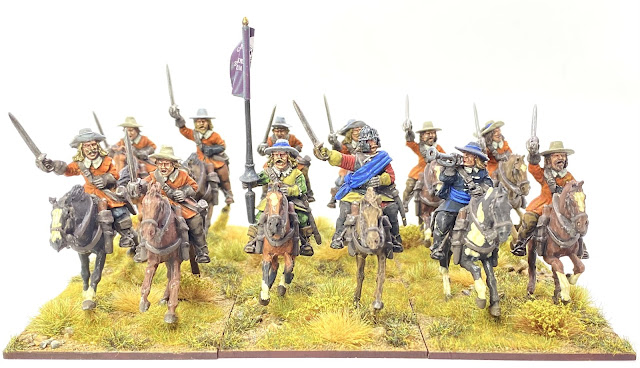
Finnish Horse (the ‘Hackapells’) - 28mm cavalry from 1st Corps Miniatures 

In this period Finland was part of the Swedish Kingdom and so the various Finnish regions provided units of horse to the national army, just as they did in Sweden itself. Although not recruited and equipped differently by design to any other of the Swedish horse, the Finns gained a reputation at the time for: ferocity, scouting, and having an air of Eastern exoticism. 

Their period nickname of ‘Hackapells’ (or perhaps ‘Hakkapeliitat’ in Finnish) referred to their battle cry of “hakkaa päälle!” or “cut them down!” that, no doubt, led to their ferocious reputation.  They often seem to have been used to clear away enemy light horse, such as the Croats, when fighting in Germany, and also to have been used in the role as scouts being Gustav Adolph’s “best Cavallerie for Discoverie”.

As with all of the Swedish horse, it is difficult to be precise about exactly how a particular unit was equipped. We know that in general Swedish horse were often short of armour, and that the Finnish units were from poorer areas of the Kingdom, so I thought a unit equipped only in ‘riding coats’ would work for the Fins. I have seen some suggestion that they wore morion type helmets but I preferred the classic look of the broad brimmed hat, also used in the picture in the Osprey ‘The Army of Gustavus Adolphus (2) - Cavalry’ by Richard Brzezinski.

To represent the Finnish cavalry I have used a set of figures from 1st Corps Miniatures.  (https://1stcorps.co.uk/product-category/horse-musket/english-civil-war/)  1st Corps are a long established UK manufacturer of metal figures in 28mm covering an extensive range of periods, including ECW and TYW ranges.  At a recent-ish demo game I was asked if I’d used any 1st Corps figures and I had to admit that I had not, although I’m not sure why (hi to James from Shakos and Sprues!).  I thought this was a good prompt and so when looking for cavalry figures I decided to have a good look through the 1st Corps ranges.  

1st Corps do figures in packs of three but also have ‘unit’ deals for units of 12 figures, which is perfect for my cavalry units. In their ECW range they had a nice set of cavalry with no armour, with soft hats, on galloping horses, and with their sword arms very much suggesting they are keen to cut down the enemy. These seemed perfect for Finnish horse.

The 1st Corps figures are classic metal 28mm figures and needed the typical amount of clean up for figures of this type. The troopers and officer have separate sword hands which have a neat way of attaching to the figures’ arms, and allow a nice amount of variety in how the resulting figures look.  The figures have nice ‘chunky’ details that were easy to paint.  I did do a couple of minor conversions.  I added a ‘Swedish cavalry’ head from Warlord to the officer, and changed the Trumpeter’s montero hat for a broad brimmed hat.   The striking orange coats were again inspired by the Osprey book. 

I couldn’t find flags, known for certain, for the Finnish horse in this period, and so I used a Swedish cavalry cornet from ‘Mikhail Betskii Creation’ that I liked the look of.  1st Corps also do casualties (horses and unhorsed riders) so I was happy to add another ‘wound marker’ base to the collection.  The MDF base is from Charlie Foxtrot.

Next on the painting table I’m looking to try my hand at some resin buildings, which is an interesting change from figures, and the remainder of the Yellow Regiment are also looking at me impatiently from the lead mountain of opportunity! 

Until next time, 

Andy @ The Friends of General Haig (FoGH)


Wednesday, 16 November 2022

Salute 50 - Planning For A Major Project Milestone

I find that it really helps my projects to have a target date for them to aim at, and what could be a better target than taking the project to one of the UKs biggest shows.

The 22nd April 2023 will be the 50th Salute show put on by the South London Warlords. As it has been for the last few years, Salute will be held at the ExCeL Centre in the heart of London’s docklands. The Friends of General Haig will be putting on two demo games. One will be my 1627 Dirschau / Tczew game, in 28mm, pitting Gustav Adolph’s Swedes against Hetman Stanisław Koniecpolski’s Poles & Lithuanians. The other game will be a Modern 15mm game set in the Middle East (more details to come later!).

Tickets for the show are up for sale here: https://www.seetickets.com/event/salute-50/excel/2379926

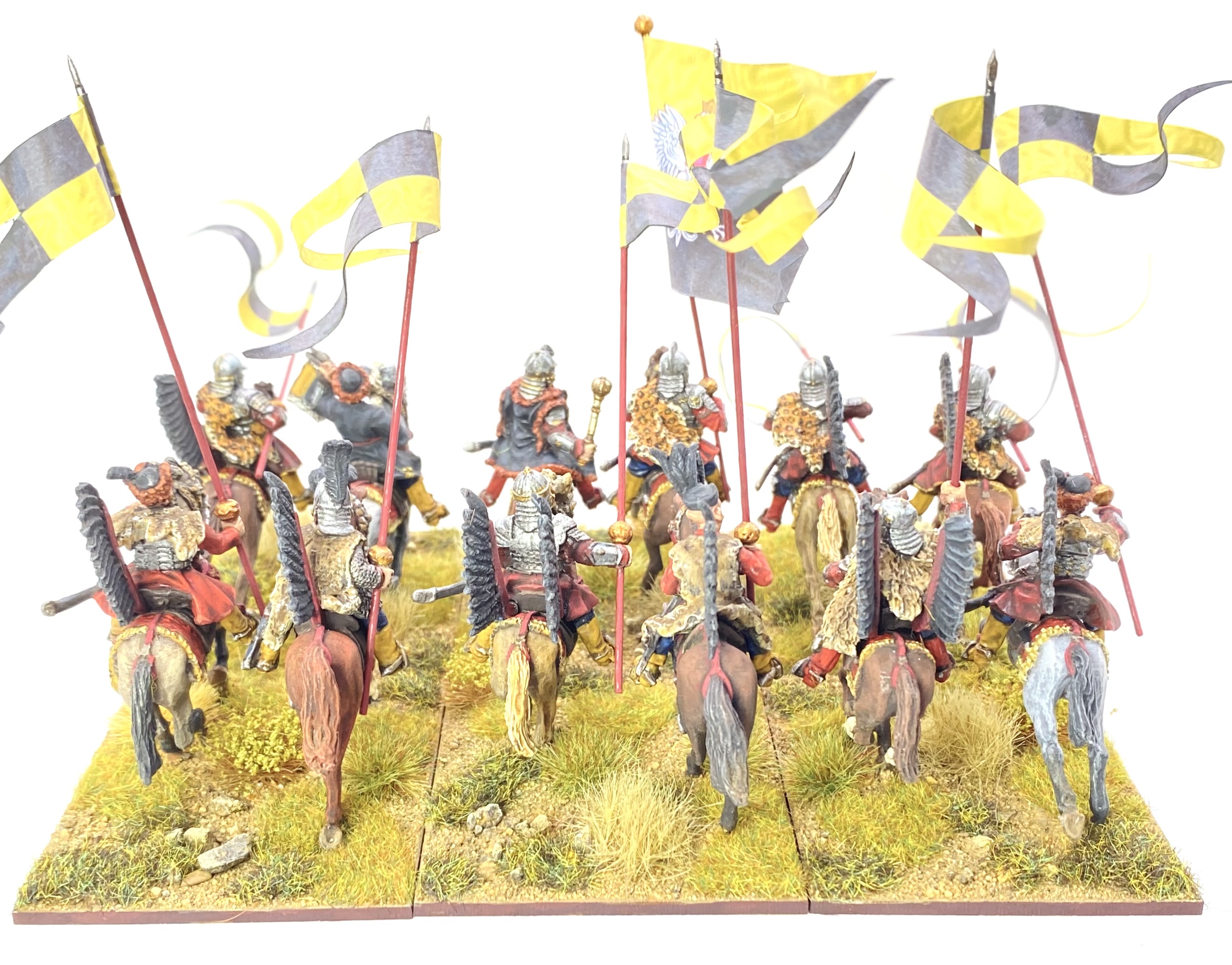
Massed Polish cavalry.

Any followers of the blog will be aware that I have been working on the armies for the 1627 Dirschau / Tczew game for a couple of years already, so not too much more to do on the figures. I’m expecting to finish the Swedish army this year, and then complete the Poles, with a crescendo of Hussars, in the New Year. 

Swedish infantry under attack.

Plans for the terrain are also underway.  Here is an outline of the terrain requirements:

  • The overall battlefield will be based on a new fur mat that I am making. The basic shape of 12’ x 6’ is now stuck together, and there is some shaving and painting left to do. 
  • At one end of the battlefield will be the edge of the walled town of Dirschau / Tczew, further defended by earthworks that also encompass the Swedish camp.   The town and earthworks will be using resin models that need to be painted.
  • At the other end of the battle field there will be an earthwork fortified camp for the Polish-Lithuanian Commonwealth army.  More resin earthworks along with ‘camp clutter’ required here.
  • There will be two small villages to be added, and also a large area of marsh to be worked out.

Working out terrain placement.
The tricky job of connecting length of fur together. 

As you can see, plenty to keep me busy!  I will continue to provide updates here as the project progresses. 

Until next time!

Andy @ The Friends of General Haig (FoGH)


Wednesday, 9 November 2022

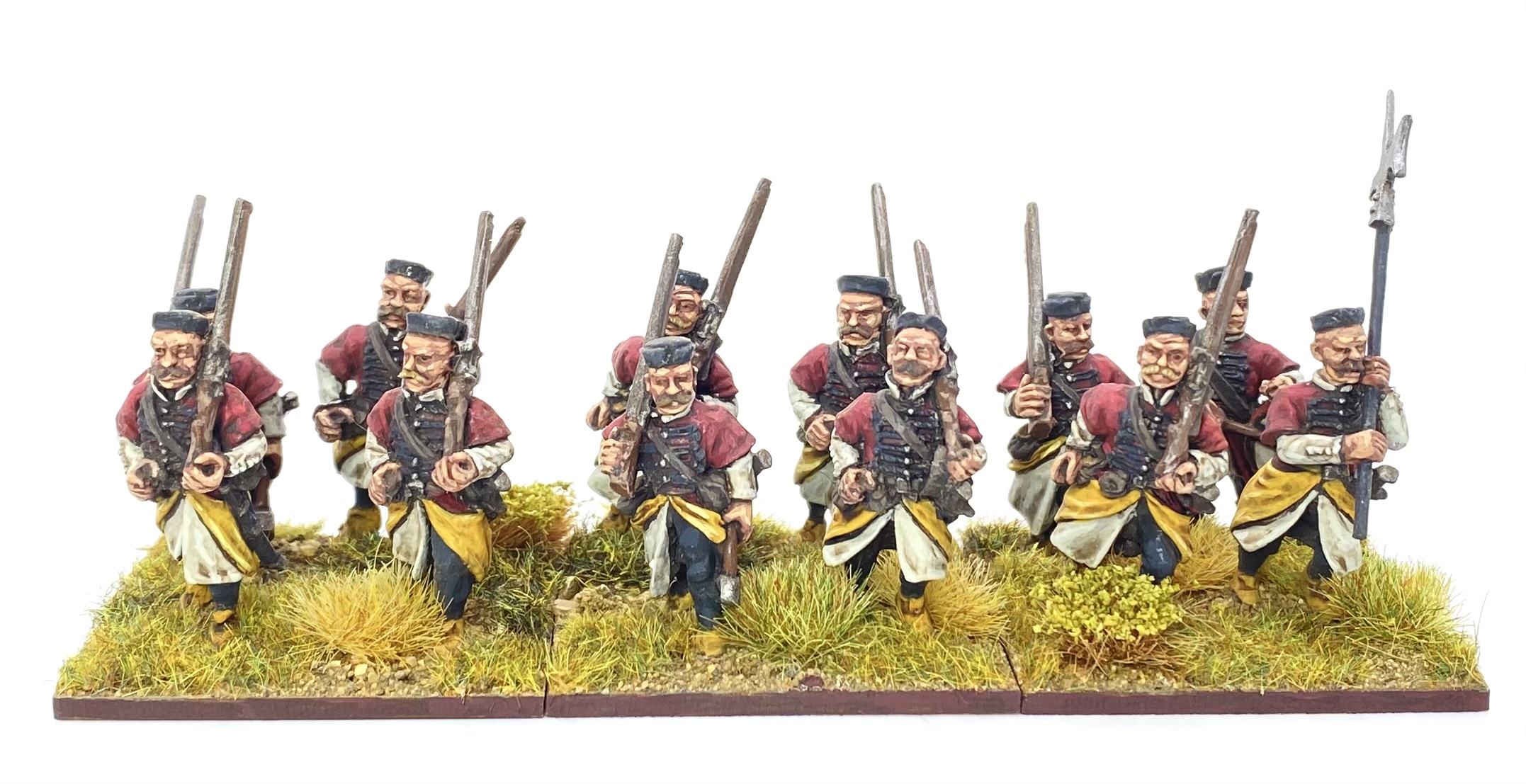
Life Guard On Duty

This post covers the latest addition to my Yellow Regiment in Gustav II Adolph’s 17th century Swedish army.

The Life Guard Company - 28mm figures from TAG, Avanpost, Brigade Games and Warlord.

The observant will have spotted that these figures are in grey and not yellow. These figures represent the ‘Drabant’ or ‘Life’ Guard company that were typically brigaded with the Household or ‘Yellow’ regiment. The Life Guard company was the most senior unit in the Swedish army and was always enlisted.  It was the king’s personal guard and so accompanied him where ever he went, including on campaign. While on campaign they would fight in battles alongside the Household (or ‘Yellow’) regiment.

Musketeers and ‘Pikemen’ from TAG

Joining the Life Guard was considered extremely prestigious and it had a high percentage of Swedish nobles and former officers amongst its ranks.  It formed a sort of cadre for the Swedish officer corps with some officers, waiting for appointments, sometimes serving in the Life Guard until a suitable position became available.

While The Life Guard performed ceremonial duties, they were also expected to be effective combat troops, and so were equipped and trained like other Swedish infantry companies; with muskets and pikes. They were uniformed at the King’s cost. As befitted their status, the Life Guard were more richly clothed than other units. Although there is a lot of documentation still available that covers the costs of their uniform, there is very little precise information about exactly how they appeared.

From what I have been able to find out they were equipped with grey clothing in 1622, and had grey cassocks, decorated with silver lace, by 1628.  I have therefore chosen to have my Life Guard in the same style of uniform as the Yellow Regiment, but in grey, and I’ve added some flourishes, like buttons, in silver grey.  The pikemen at some point were equipped with buff coats.  I have chosen to keep them in armour, as this is what the TAG cassock uniformed pikemen are wearing.  I have shown the officers with buff coats under their cassocks.  The pikemen used partizans when on ceremonial duties, and pikes when on the battlefield, but I couldn’t miss the opportunity to have the partizans! 

As a relatively small formation I am just representing the Life Guard as a couple of bases, that will form part of the overall Yellow Regiment.  I expect it will be easy to not even notice them amongst the swathes of yellow, but it is the sort of detailed touch that, for me, makes the overall unit fun to collect. 

Command base with Avanpost ensigns and drummer, and officer from Brigade Games

The pike and musket base use the Swedish cassock uniformed figures from The Assault Group (TAG) range.  I also included a command base so that I could have the Life Guard colours produced by Flags of War.  I wanted some suitable officer looking figures and found some in the pile of opportunity that had suitable cassock-like clothing.  The officer, the captain-lieutenant as Gustav himself was considered the captain of the company, is from Brigade Games, and the two ensigns and drummer figures are from Avanpost Miniatures.  I have shown the drummer in a black uniform with yellow trim as these were the colours of Gustav Adolph’s family heraldry.  Musicians are supposed to have fancy uniforms for ceremonial occasions in these colours, but they probably didn’t were them on campaign.  Once again I’ve gone with the pretty option over the more likely! 

Flags from Flags of War

Finally I needed a casualty marker for the Drabants. This one comes from the Warlord Pike & Shotte range.

Casualty figure from Warlord, and counter base from Warbases.

Next on the painting table are some of the Swedes northern brethren, the Fins, and a first for me. 

Until next time!

Andy @ The Friends of General Haig

Friday, 21 October 2022

Heavy Horses

This post looks at the latest unit on my painting table, a unit of Cuirassiers for my Swedish army of the 1620s. 

28mm Avanpost Cuirassiers.

This is the second unit that I’ve created using Avanpost’s 28mm resin figures (see the previous one here: https://theviaregia.blogspot.com/2021/06/ake-totts-cuirassiers.html).  I’m not very confident about the longevity of these rather fragile figures but they are lovely to paint! 

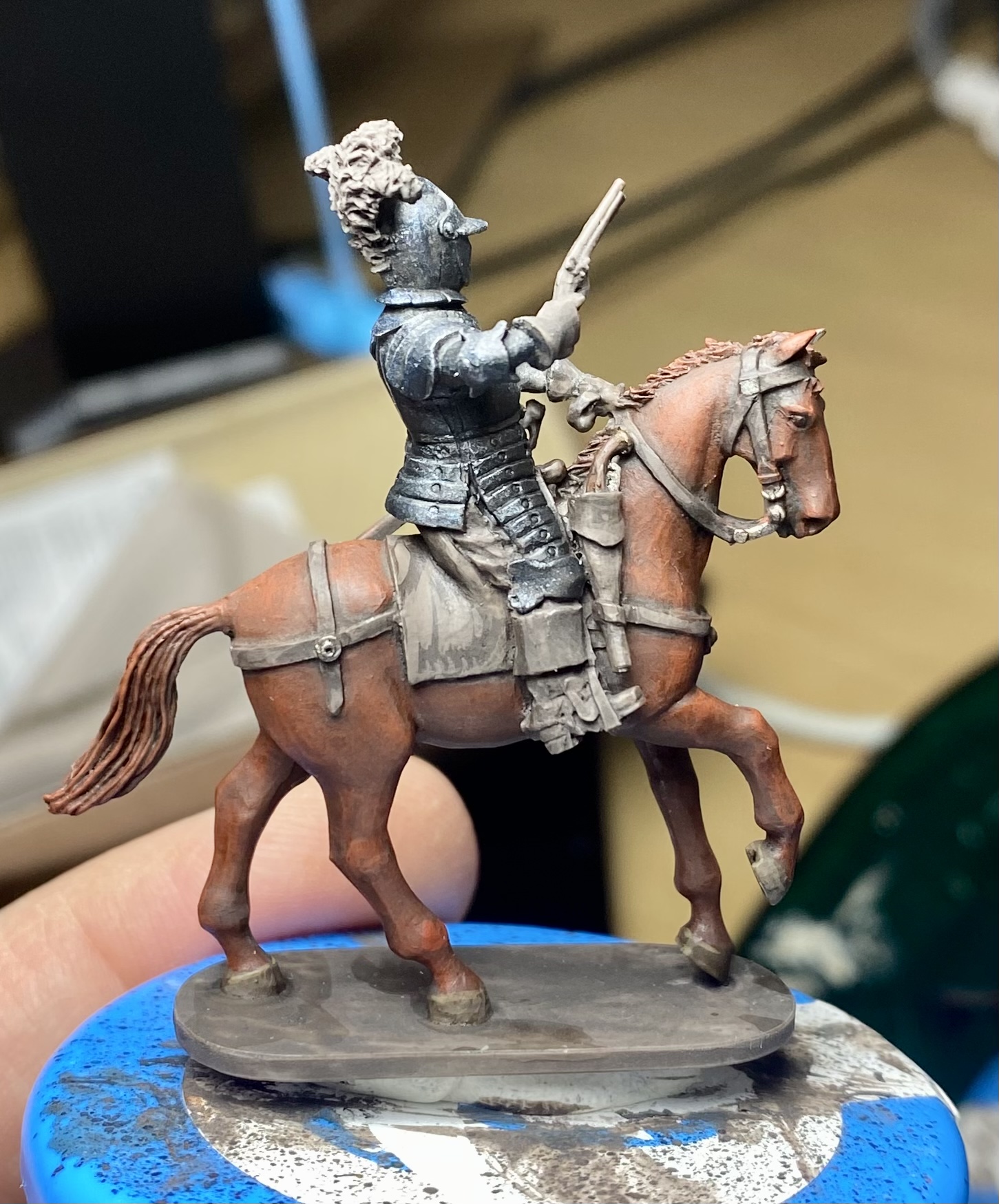
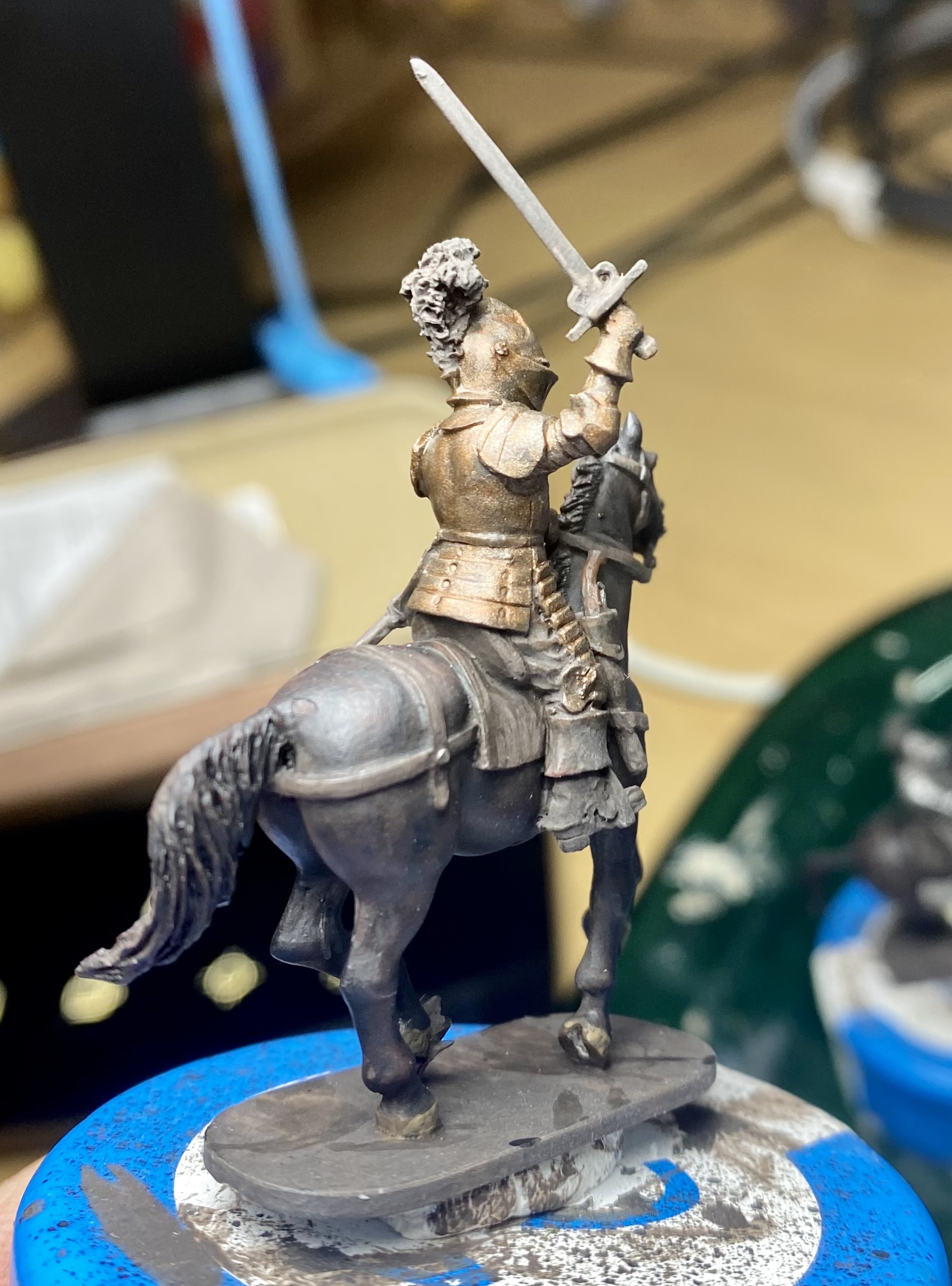
After seeing someone else’s unit with different finishes of 17th century cuirassier armour (hello to Paul Mackay on Facebook!) I decided that I would have a go at a mixture of armour finishes.  I have also always liked the Angus McBride illustration in the Osprey Elites title on English Civil War Cavalry that shows Haselrigge’s lobsters with three types of armour finishes. Untreated metallic armour would have rusted very quickly and so metal armour typically had some form of protective patina added. 

Base coat of mixed gunmetal, black contrast and blue metallic.

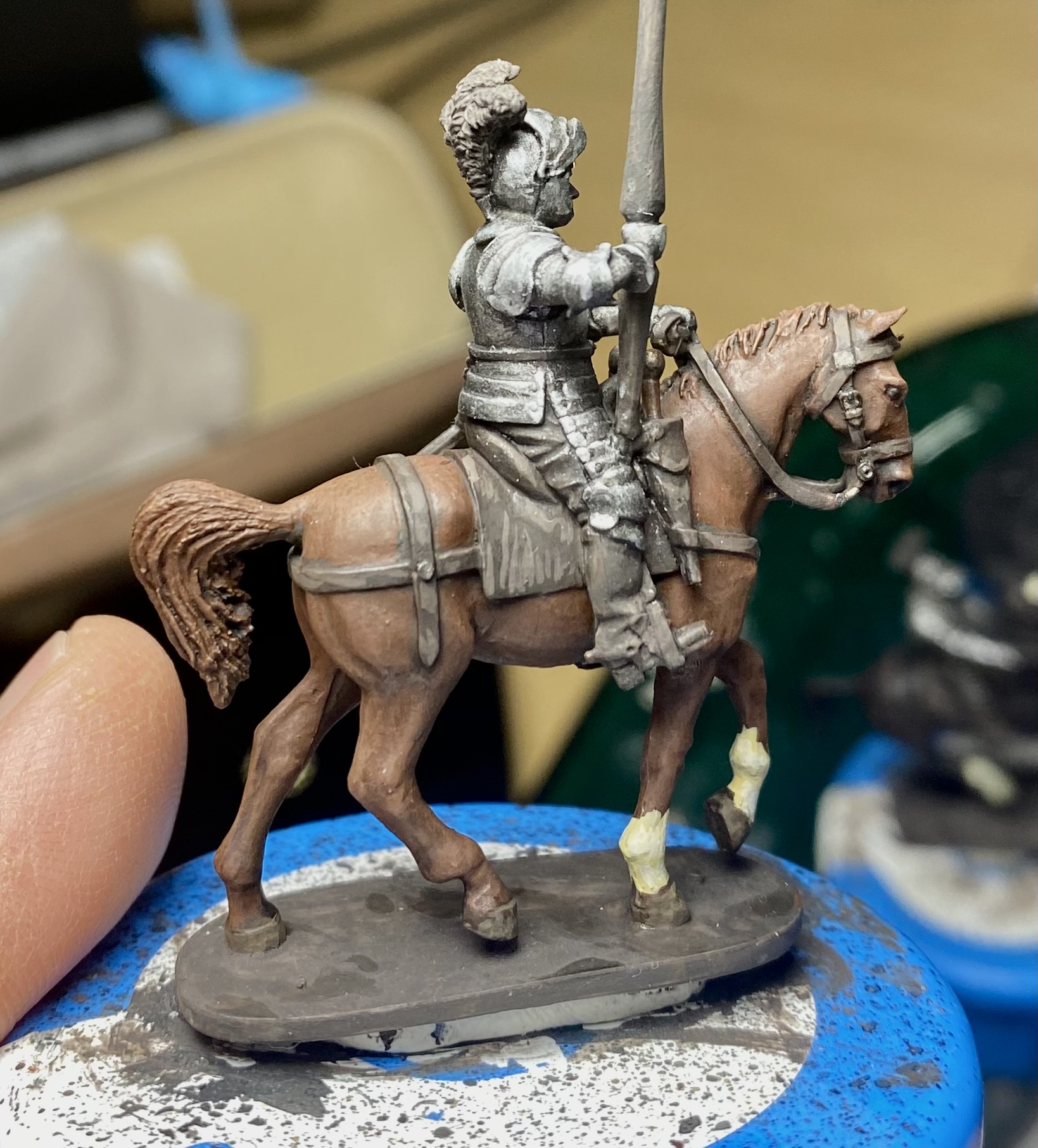
Dry brush of steel and dark wash applied.

Blackened armour was probably the most common (and cheapest) finish and this could be achieved by coating the heated armour with linseed oil and soot. To achieve something like this on my miniatures I used a base coat of equal parts of GW Leadbelcher, VMC Blue Gunmetal and GW Contrast Black Templar. Over this a dry brush of GW Ironhands Steel, and then a final wash of thinned GW Nuln Oil.  By adding more of the Blue Gunmetal in the base then a bluer finish can be achieved which was a considered a more desirable, and expensive, finish in the 17th century. 

Base of gunmetal, washed with red-brown contrast.

Dry brush of steel added. 

Russeting was another patina finish which gave a reddy-brown finish, and was most popular in the 16th century.  One 17th century recipe I’ve seen for this suggested oil and vinegar. To represent this I used a base of Leadbelcher with a ‘wash’ of GW Contrast Fyreslayer Flesh. Finally a light dry brush of Ironhands Steel. 

Gumetal base, dry brush with steel, and highlight with silver. Final dark wash. 

It is also possible that some individuals may have kept their armour ‘white’ (plain metal, uncoloured) if they had the available man power to constantly polish and clean it. For this I used a base coat of Leadbelcher, a dry brush of Ironhands Steel, and a wash of Nuln Oil.  For a really fancy finish (for the Cornet) I painted on some VMA Silver as a highlight.

I like the final look of the cuirassier unit in their fancy armour, and it was fun to play armour with the armour recipes. 

The cornet (flag) is from Mikhail Betskii Creation.

The trumpeter rides a Piebald horse, a popular choice in the Swedish cavalry.

As with most of my recent units I added a casualty tracker base for the unit.  This uses one of the lovely Bloody Miniatures ‘Dismounted Cuirassiers’ next to a Avanpost wounded horse.  The base is from Charlie Foxtrot. 


Next time, back to the infantry. 


Until next time,

Andy @ The Friends of General Haig (FoGH). 


Tuesday, 4 October 2022

“And it was all yellow”

 This post looks at the latest unit for my 1620s/30s Swedish ‘Yellow’ Regiment. 

28mm figures from The Assault Group (TAG).

The latest unit is another ‘sleeve’ of shot for the expanding Swedish Squadron. All 28mm figures from The Assault Group (TAG). I made one head swap, on the sergeant. The original figure was wearing a Montero, but I preferred to have him in a helmet and so made a swap with a spare TAG figure. 

Rear view showing their swords etc.
Rear view, with the sergeant and drummer on the right hand side.
Casualty from Warlord Games and counter base from Warbases.

I’m definitely getting the hang of these now, and quite enjoying the uniformity. 

The Yellow Regiment, so far. (The command group are from Warlord Games.)

Here are the three completed units together;  the pike unit with two sleeves of shot, and also a command base I completed for the Yellow Regiment sometime ago (all Warlord figures, see here for more details https://theviaregia.blogspot.com/2019/05/generalmajor-count-nils-brahe.html).

They obviously know where they are going, and they’re off! (Flags from Flags of War.)

Next on the painting table, a respite from the yellow, and some ‘heavy metal’ horse for the Swedes. 

Close up on the Warlord Games command group.

Until next time!

Andy @ The Friends of General Haig.